|
Hayawic Logic Application to Test Pattern
Generation Using the Interest Square Unity (ISU) Technique
Marguerite “Peggy” J. Palmer
INFT 858 Class Project
Professor Alnakari
Spring 1998
George Mason University
Fairfax, VA
Table of
Contents
i. Abstract
ii. Preface
I. Introduction
II. Overview
·
Problem Statement
·
Objective
·
Methodology
·
Justification
·
Expected Results
III. ISU and Unilogic Form
Application
·
Overall Problem
·
Four existing
methodologies
·
Approach 1 -
B-Algorithm: A Behavioral Test Generation Algorithm
·
Approach 2 -
System Level Fault Simulation
·
Approach 3 -
Behavioral Test Generation using Mixed Integer Non-linear Programming
·
Approach 4 - Test
Synthesis in the Behavioral Domain
·
Conclusion
·
Overview of State
of the Art in Commercial Design for Test Tools
·
Use of ISU and
Unilogic Form to Solve Problem Using a New Holistic Approach
·
Application of
Interest Charge Elements (ICE) to Fault Detection
·
Abstract Test
Generation Case Analysis
·
Approach 1 ISU
Analysis
·
Approach 2 ISU
Analysis
·
Approach 3 ISU
Analysis
·
Approach 4 ISU
Analysis
·
Results
·
Direction for New
Holistic Approach
IV. Conclusion
Appendix A - Key Concepts
and Terms
Appendix B - Description of
Recent Design for Test Tool Implementation
Appendix C - Bibliography
of Design for Test Research Papers
Appendix D - List of
Sources Contacted and Information Provided for this Project
Abstract
This paper examines the various issues
associated with a behavioral level methodology for achieving 100% fault
coverage in Complementary Metal Oxide Semiconductor (CMOS) Very Large
Scale Integrated (VLSI) circuits. First, research on fault models and
their applicability to CMOS is explored leading to a basis for determining
fault coverage. Second, a number of behavioral test generation techniques
are evaluated for their ability to detect faults and to achieve 100% fault
coverage. The conclusion indicates the need for further research at the
behavioral level to achieve 100% fault coverage for CMOS VLSI circuits.
The Interest Square Unity (ISU) technique,
a tool of Unilogic, was developed by the Damascus School of Hayawic Logic
and offers a systematic method of selecting, analyzing, and solving any
problem. The ISU can be shown graphically to contain four global states,
with each state representing the possible locations of the entity in its
existence. It represents a logic in that the state transitions can be
made from one state to another. It can be used as an analysis tool
because each state can be used to represent the factors or perspective of
the problem.
ISU could be used through analysis and
design to help improve fault models, fault coverage, and address any test
pattern generation areas which are not well supported by current Design
for Test (DFT) tool suites. Therefore, this paper will limit its scope to
analyzing only the four behavioral level test generation approaches since
they represent a range of techniques which support design for
testability. Also, since there is so much research in this field, the
four approaches will be used as representative cases to show the utility
of ISU for analysis of them.
As ISU is applied to the test generation
problem, several solutions should become apparent for solving the
behavioral level issues for achieving 100% fault coverage in CMOS VLSI
circuits. ISU and Unilogic can then be applied to each of the four
different test generation techniques presented. This will evaluate their
ability to detect faults and to achieve 100% fault coverage to see where
they exist in the universe of test generation. Finally, ISU can be
applied to help address the problem and develop a direction for solving
it. ISU will not solve the problem but will provide an analysis tool
which will provide insight on the dimensions and the dynamics of the
problem and the result will be a new direction from which to solve the
problem.
Our objective is to determine a Unilogic
form which can help steer further research efforts in the direction which
can be one alternative to achieving the holistic testing approach. The
differences in this approach compared to the other four will be described
and it will be shown how this new holistic approach direction may be used
to analyze and discover the different types of faults in CMOS VLSI
circuits. Lastly, we will discuss what the expected results would be if
the new direction were to be pursued and whether the new holistic approach
can be implemented and what would be required. Also, we will describe
what criteria should be used to test the efficiency and effectiveness of
this new holistic testing approach based on ISU.
Preface
This paper was prepared in partial
fulfillment of the requirements of ECE858, Object Oriented Modeling and
Artificial Intelligence, Spring Semester 1998, George Mason University,
under the professorship of Dr. Raiek Alnakari.
This work began at the midway through the
semester. Many sources for information were contacted during this
project and a list of those contact and the status is available in
Appendix D. Much of the detailed information to accomplish more
in-depth analysis was either not available or arrived close to the end of
the project and therefore was not as fully factored into the
analysis, however it can be used for any potential follow-on work pursued.
The objective of this project is to apply the Hayawic Unilogic
approach to the problem of providing a high level of fault coverage in
digital integrated circuits.
Preliminary results were produced from this
work but additional research is required to fully benefit form the Unilogic approach and to derive more specific solutions. I would like to
thank Dr. Alnakari for providing valuable guidance and direction for this
project.
ABOUT THE AUTHOR:
Marguerite J. Palmer is currently a Major
in the U.S. Air Force and is assigned as the Radio Frequency Spectrum
Manager for the Military Communications-Electronics Board for the Command,
Control, Communications, and Computers (C4) Directorate of the Joint Staff
in the Pentagon, Washington, DC.
She has served as a Deputy Division Chief for
an Intelligence Dissemination System Program Office; Legislative Liaison
and Program Manager, On-board Processing and Microelectronics Programs for
the Ballistic Missile Defense Organization (BMDO);
Lead Engineer for an Early Warning Satellite System Program Office;
and a Program Control Officer for an
Advanced Communications Program Office.
Maj Palmer is
currently working on a PhD
and holds a MEEE
from the University of Virginia, an MBA from Chapman University, and a BS
from Rensselaer Polytechnic
Institute.
Introduction
This
paper will address an area which is extremely important for information
technology, computer engineering, and telecommunications fields. Large
integrated circuits (ICs) are the key elements which have made possible
the high performance of personal computers and the ability to use
multi-media and real-time interactive applications. The challenge for the
IC designers is to ensure that their large, complex chips function as they
are intended to. That is, they can operate correctly and without faults.
Or, if there are faults, they do not corrupt the proper operation of the
circuit and produce erroneous results. Recall several years ago when a
researcher discovered that an Intel Pentium microprocessor produced errors
during certain operations. Intel at first did not take this news
seriously and said that most users would never notice this erroneous
behavior. However, to their surprise, users of PCs did not want to have
the “faulty” microprocessor in their system. Therefore, there was a very
large public outcry for replacing the bad ICs. Intel finally responded by
announcing they would replace all the microprocessors free of charge.
In order
to avoid this negative experience from recurring, the IC community wants
to ensure that the chips that finally make it to the commercial world are
fault-free. In order to do this, they must have a way to test these
complex chips for the presence of faults. Challenging chip test is the
large number of test patterns that have to be generated to completely (or
exhaustively) test the circuit. For example, if you have a simple digital
circuit with two inputs and one output, you can test all 9 input
combinations by applying the following inputs: (00), (10), (01), and
(11). This turns out to be 2N test patterns. This is very
manageable for small circuits because you can easily generate the input
combinations and verify that the actual output matches the expected
output, thus verifying correct circuit operation. However, for a circuit
with 64 inputs, 264 input patterns equal 1.84 x 10¹⁹
different input patterns which becomes an impossible number to
exhaustively test. Therefore, automatic test pattern generation has been
a booming research field. In addition, the ability to measure an IC’s
design quality by the fault coverage is an extremely important measure of
merit. For ICs, most faults are produced during the manufacturing IC
process, by such things as defects, extensions or omissions in the various
layers such as the gate oxide, the metalization, the polysilicon, which
can create shorts, opens, or extraneous circuit behavior creating faults.
Many different types of faults exist and a very large number of algorithms
and models have been developed to help detect these faults.
Fault
coverage is defined as the number of detected faults divided by the total
number of faults, and is given in a percentage. Fault coverage figures as
close to 100% are desired. Usually simulation is used to measure the
fault coverage of a circuit with fewer than 200,000 logic gates, which are
typically NAND or NOR gates. But with ICs with over 4 million transistors,
this means they have approximately 1 million logic gates. For ICs with
more than 200,000 gates, simulation is very time consuming and
computationally intensive. For those tools which can handle such a
design, the fault simulation can take can take several weeks or even
months to complete.[1]
Therefore, Design for Test (DFT) techniques are required.
DFT is a
booming field. The world leader in DFT tools is Mentor Graphics. Mentor
Graphics is an important supplier of both automatic test pattern
generation (ATPG) and memory and logic built-in-self-test (BIST) software,
critical for deep submicron design, while also offering the industry's
most complete line of DFT solutions. Mentor Graphics Corporation (NASDAQ:
MENT) is a leading supplier of electronic hardware and software design
solutions, providing products and consulting services for the world's
largest electronics and semiconductor companies. Established in 1981, the
company reported revenues over the last 12 months of $455 million and
employs approximately 2,570 people worldwide. Company headquarters are
located at 8005 S.W. Boeckman Road, Wilsonville, Oregon 97070-7777.[2]
A recent
query on the Internet under the search phrase of “faults and test pattern
generation” using the Alta Vista search engine resulted in over 1.67
million web page hits. Obviously, there is considerable research ongoing
in this field. In addition, University of California at Santa Barbara is
teaching a sophomore level Electrical and Computer Engineering class in
VLSI Testing Technique by Dr. K. T. Tim Cheng located at timcheng@ece.ucsb.edu.
Therefore, any improvements in the ability
to improve the abilty to test ICs or to improve fault coverage is highly
desired. This paper will address exactly that. This paper examines the
various issues associated with a behavioral level methodology for
achieving 100% fault coverage in Complementary Metal Oxide Semiconductor (CMOS)
Very Large Scale Integrated (VLSI) circuits. First, research on fault
models and their applicability to CMOS is explored leading to a basis for
determining fault coverage. Second, a number of behavioral test
generation techniques are evaluated for their ability to detect faults and
to achieve 100% fault coverage. The conclusion indicates the need for
further research at the behavioral level to achieve 100% fault coverage
for CMOS VLSI circuits.
The Interest Square Unity (ISU) technique,
a tool of Unilogic, was developed by the Damascus School of Hayawic Logic
and offers a systematic method of selecting, analyzing, and solving any
problem. The ISU can be shown graphically to contain four global states,
with each state representing the possible locations of the entity in its
existence. It represents a logic in that the state transitions can be
made from one state to another. It can be used as an analysis tool
because each state can be used to represent the factors or perspective of
the problem.
ISU could be used through analysis and
design to help improve fault models, fault coverage, and address any test
pattern generation areas which are not well supported by current Design
for Test (DFT) tool suites. Therefore, this paper will limit its scope to
analyzing only the four behavioral level test generation approaches since
they represent a range of techniques which support design for
testability. Also, since there is so much research in this field, the
four approaches will be used as representative cases to show the utility
of ISU for analysis of them.
Our objective is to determine a Unilogic
form which can help steer further research efforts in the direction which
can be one alternative to achieving the holistic testing approach. The
differences in this approach compared to the other four will be described
and it will be shown how this new holistic approach direction may be used
to analyze and discover the different types of faults in CMOS VLSI
circuits. Lastly, we will discuss what the expected results would be if
the new direction were to be pursued and whether the new holistic approach
can be implemented and what would be required. Also, we will describe
what criteria should be used to test the efficiency and effectiveness of
this new holistic testing approach based on ISU.
Overview
Problem Statement
Integrated circuit complexity is
increasing at a tremendous pace based upon advances in high level design
tools, microprocessor performance improvements, and smaller feature size
process technology. Unfortunately, conventional test generation
techniques are challenged by this increased complexity, the need for test
vector generation and fault simulation in a timely manner, providing
adequate fault coverage, and the newer process technologies requiring
additional fault models. Much Very Large Scale Integration (VLSI) design
is conducted using behavioral level design tools such as Very High Speed
Integrated Circuit (VHSIC) Hardware Design Language (VHDL). Numerous
advantages can be gained by test generation conducted at this same level.
Most gate level test generation techniques rely on fault models, such as
the single stuck-at (SSA) fault, which do not completely characterize the
fault modes for Complementary Metal Oxide Semiconductor (CMOS) circuits.
Lastly, high fault coverage, preferably 100%, is desired for long term
Integrated Circuit (IC) applications where devices must operate as
expected in the presence of faults without repair. Therefore, much
benefit can be gained through 100% fault coverage using behavioral test
generation techniques for CMOS ICs.
Fault modeling can occur at many levels
such as the electrical, logical, functional, register-transfer level, or
behavioral. Regardless of the level, the objective of fault modeling is
to accurately represent the physical faults so that the circuit can be
simulated and test vectors generated to detect as many of the faults as
possible. Physical faults, such as a short circuit, can be modeled at the
electrical level, providing higher accuracy but at the expense of
increased computational complexity whereas the same fault can be modeled
at the logic gate level with greater simplicity. As one attempts to model
faults at higher levels of abstraction, such as the functional or
behavioral level, these models must cover a wide range of physical
faults. These models, by virtue of their simplicity, may not detect all
physical failures for which they are designed to cover. However, the
tremendous circuit complexity of VLSI makes it paramount to develop
behavioral level fault models which can be executed in a reasonable time
and yet provide a high degree of fault coverage.
To better understand fault detection and
test generation, a simple example will be provided. We will use a
half-adder circuit and show how a fault can impact its correct operation.
A combinational logic circuit can be viewed as a box with n inputs and m
outputs. For n inputs, there are 2n possible combinations of
binary input values. For each input combination, there is only one output
combination. Shown below is the one Boolean logic truth table for the
half adder with x and y as the two input variables and C and S as the
Carry and Sum output variables. A half adder performs the addition
operation of two binary digits, which are 0+0=0, 0+1=1, 1+0=1, and
1+1=10. When both inputs are 1, the binary sum produces a two digit
binary number, where the right bit equals 0 x 20 = 0 and the
left bit equals 1 x 21 = 2, which is the expected answer when
adding 1 to 1.

One implementation of the half adder is
shown below using one AND gate and one exclusion or (XOR) logic gate. The
truth table for correct operation is also shown.
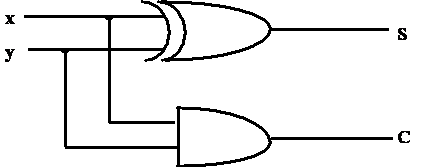
HALF ADDER IMPLEMENTATION
x y / C S
0 0 / 0 0
0 1 / 0 1 HALF
ADDER TRUTH TABLE DIAGRAM
1 0 / 0 1
1 1 / 1 0
If one of the inputs, for instance x, is
stuck at 1, from perhaps an electrical short shown at location X between
the input wire x and the power supply line, then regardless of the value
provided for the x input, the combinational logic will always interpret
its value as being 1. This is called a single stuck at one (SSA1) fault.
The truth table will now be shown with the faulty input. By comparing its
output with the correct truth table output above, one can see where the
fault will produce erroneous output data. These incorrect values produced
by the SSA1 at x fault are shown in bold and underlined below.
x y / C S
1 0 / 0 1
1 1 / 1 0
FAULTY HALF ADDER TRUTH TABLE DIAGRAM
1 0 / 0
1 FOR x SSA1
1 1 / 1 0
The process of test generation involves
determining what type of fault one wants to test for and at what fault
site. If we wanted to test for the SSA1 fault described above at the x
input line, then we would activate the fault. This means setting the x
input value to 1. In this case x is both the primary input, which is an
input line whose value can be controlled or set, and the fault site. Then
we would propagate the fault to a primary output. Primary means that you
can observe the value on the output. In this simple example, these steps
are trivial because the fault can be set at a primary input and the
results can be seen at a primary output. However, in larger circuits, one
must propagate the values at the fault site to a primary output. This
involves selecting all the subsequent values of signals that would
interact with the value at the fault site to ensure that they pass the
value you are testing for to a primary output unchanged. One also has to
select the input values which would activate and test for the fault.
Further challenging fault model
methodology are process technology dependencies producing different types
of physical defects, thereby creating different fault types. However, one
fault model, the single stuck fault, ssf, model is almost always used as a
basis for fault grading.[3]
McCluskey explains that although different fault models exist, such as
multiple stuck fault, bridging faults, delay faults, stuck-open faults,
etc., the ssf is the most prevalently used. His reasons are the big
investment in the ssf, it creates many test patterns applied to a single
gate resulting in propagation to a primary circuit output, and fault
simulation can determine the coverage of ssf test patterns and a high
fault coverage indicates that the test set is close to a gate exhaustive
test.
Other research indicates that the ssf
model was based and applied to early digital circuit and that high ssf
coverage can no longer guarantee high quality for CMOS ICs.[4]
Soden and Hawkins explain different fault simulators give different
results and often calculations are modified to produce high ssf coverages.
They also state the ssf model doesn’t accurately reflect CMOS IC defects
and failure mechanisms which produce effects other than a single stuck-at
node. They recommend replacing abstract models with realistic defect
models, such as the transistor bridging model, and using test methods such
as IDDQ and at-speed testing to minimize the difference between
actual and predicted defect coverage.
Research by John P. Shen, et al[5]
developed Inductive Fault Analysis (IFA) to predict all faults expected to
occur in a Metal Oxide Semiconductor (MOS) IC based upon the IC layout.
The result is a fault model and a ranked fault list which factors in the
technology, layout, and process characteristics. They applied their
method to an NMOS modified full-adder circuit having 4 inputs, 3 outputs,
and 29 transistors. The results indicated that out of the original 4800
defects, only 476 would produce faulty behavior at the circuit level.
These are further broken out by fault type: 28% line stuck-at faults, 15%
transistor stuck at faults, 21% floating line faults, 30% bridging faults,
and 6% miscellaneous faults. Therefore, the classical stuck-at fault
model, which could explicitly model the first type and implicitly model
the second and third type faults, could only account for 64% of all the
faults. This leaves 36% unaccounted for, of which bridging faults were
the predominant fault type. They felt that although this was an NMOS
circuit, the results apply to CMOS circuits. Their IFA procedure can be
used to develop automatic test generation programs using the ranked fault
list.
Abramovici states[6]
that high fault coverage for ssfs is a necessary but not sufficient
condition to achieve high defect coverage. He defines the correct way of
computing (absolute) fault coverage as FC=D/T where D is the number of
detected faults by an automatic test generation program and T is the total
number of target ssfs. He further shows how another measure, called
detectable fault coverage, defined as DFC=D/(T-U), where U is the number
of undetectable faults, is not a reliable measure of fault coverage for
either sequential or combinational circuits because the undetected faults
can impair circuit performance or mask other faults. Therefore, test
generation must not only target all relevant fault classes, beyond the ssf,
but needs to detect all faults in order to achieve 100% fault coverage in
CMOS ICs.
The environment is test generation of
very large scale integration (VLSI) Complementary Metal Oxide
Semiconductor (CMOS) integrated circuits. The problem can be broken down
into the following parts:
1)
Need high fault
coverage (approaching 100%) by detecting the multiple faults types which
exist
2)
IC complexity
increasing at a tremendous rate but test generation methods not keeping up
3)
Existing test
generation and fault detection methods too computationally intensive and
too slow
Test generation techniques which depend on
an efficient fault detection methodology and accurate fault models are
either not applied well or are non-existent at the behavioral level.
Objective
The
objective is to improve fault models, fault detection coverage, and
improve the performance of automatic test generation techniques. In
addition, the desire is to move the process of test technique insertion up
in the development cycle to early in the design phase. In addition,
developing test generation techniques and fault models at higher levels of
abstraction, such as the functional or behavioral level, have the promise
to improve the test generation and fault detection execution times.
Methodology
This paper will look at four recent
concepts proposed in the recent research literature which propose a
solution to different aspects of the problem. Only four representative
papers will be analyzed to limit the scope of this work since there are
such a large number of papers in the literature. The Unilogic ISU
technique, which will be described below, will be employed as an analysis
tool to determine how well each the four research concepts address the
different aspects of the problem and where further research is required.
ISU will then be used to model the problem and a proposal for a new
direction in research will be developed.
Recent work in the commercial sector has
produced an implementation of numerous research methodologies which
address different aspects of the problem. The world leader in DFT
techniques is Mentor Graphics. An overview of their DFT tools will also
be provided. These represent the state of the art in automatic test
pattern generation techniques and fault grading. Although the scope of
this paper is limited to analyzing only the four research proposals, ISU
can be applied as a follow-on project to some of the Mentor Graphics tools
to see if there are ways of improving their performance and achieving 100%
fault coverage. Unfortunately, insufficient information on the Mentor
Graphics tools, implementation algorithms, and underlying fault models
were available to support this paper.
The methodology that will be employed in
this paper will attempt to answer the following questions:
·
Is there any new
(holistic) testing approach that can include different functions which are
currently applied in the existing methods?
·
Can the new
(holistic) testing approach solve the problem of high level fault testing
(existence separated approach)?
·
What is the
general organization and specific functions which are needed to solve that
problem?
·
Can Unilogic form
be one alternative to achieve the holistic testing approach? If yes, what
differences in approach can be achieved based on this logical approach and
how can it be used to analyze and discover the different types of faults
in CMOS VLSI circuits?
·
How can it be
implemented and what is required? Also, what criteria should be used to
test the efficiency and effectiveness of this new holistic testing
approach based on ISU?
To
reiterate, this paper will not develop a new testing approach but will use
ISU and Unilogic to determine a new direction to pursue which will lead to
a holistic testing approach which can later be implemented.
Justification (using
Unilogic Form ISU as useful for solving that problem):
ISU can be applied to this problem because
the environment of test generation has certain global states. Each of the
four ISU states can be used to represent the two variables, fault coverage
and level of abstraction, belonging to the universe of test generation.
The Unilogic form can provide a logical way to examine the various test
generation state units and better understand the rhythmic sequence of the
entity. Therefore, a better understanding of what the underlying
factors are which influence the ability to detect faults in relation to
the level of abstraction can assist in identifying a future direction to
pursue in further research of the problem.
Expected Results
As ISU, an analysis technique of Unilogic
form, is applied to the test generation problem, several solutions should
become apparent for solving the behavioral level issues for achieving 100%
fault coverage in Complementary Metal Oxide Semiconductor (CMOS) Very
Large Scale Integrated (VLSI) circuits. ISU can then be applied to each
of the four different test generation techniques presented. This will
evaluate their ability to detect faults and to achieve 100% fault coverage
to see where they exist in the universe of test generation. Finally, ISU
can be applied to help address the problem and develop a direction for
solving it. ISU will not solve the problem but will provide an analysis
tool which will provide insight on the dimensions and the dynamics of the
problem and the result will be a new direction from which to solve the
problem.
Application of ISU
Overall Problem
Test generation for
high complexity VLSI ICs is not only difficult but extremely time
consuming. Gate level fault and circuit models are cumbersome and not
computationally practical for complex VLSI circuit test generation use
because of the tremendous numbers of test vectors and large search for
solutions. Therefore, there is a need to model faults at a higher level
of abstraction such as the behavioral level, and to generate tests based
upon these fault models. However, faults unique to CMOS VLSI must be
captured and correlated as a basis for behavioral level fault models to
achieve high fault coverage. A selected set of four research efforts will
be presented to show how close each approaches behavioral level fault
modeling and high coverage for CMOS.
Four existing high level
test methodologies
·
Approach 1 -
B-algorithm: A Behavioral Test Generation Algorithm
Cho and Armstrong[7]
have proposed the B-algorithm which generates tests directly from
behavioral VHDL circuit descriptions using three types of behavioral
faults: stuck-at, stuck-open, and micro-operation—all defined by altering
VHDL constructs. The behavioral stuck-at (BSA) fault defines two
stuck-at faults (SA0 and SA1) for each bit where a bit is defined as a
signal, a virtual signal, a fanout stem, or a fanout branch. The
behavioral stuck-open (BSO) fault occurs when the value of an assignment
(the right hand side) is not transferred correctly to its target. A BSO
fault represents an open circuit in a model and can represent additional
functional faults when a control expression handles the assignment
statement. The micro-operation (MOP) fault is when an operator is
perturbed to another one or selected instead of the correct one such as
ADD instead of SUB. Test generation is performed at the behavioral level
using a good/bad value pair G/B in place of D or D’ for the D-algorithm.
The B-algorithm can generate tests with a higher equivalent gate level
fault coverage than the Behavioral Test Generator however this was not
quantified. The B-algorithm can generate tests for BSO faults which can
detect gate-level transition as well as gate-level stuck-at faults.
Lastly, it employs two-phase testing to activate BSO faults and to
propagate fault effects through control constructs. Undetermined with
this approach is the degree to which gate level and process level faults
can be accurately correlated at this behavioral level. In addition, many
actual physical faults may occur which are not taken into account at such
a high level of abstraction with an ADD operation changing to a SUB. In
contrast to this approach, the next one uses specific fault modules to
modify the VHDL code.
·
Approach 2 -
System Level Fault Simulation
Sanchez and Hidalgo[8]
have proposed a fault methodology in VHDL, independent of the fault model,
based on segments. They employ specialized fault injectors which generate
a VHDL description for each fault to model the module’s faulty behavior
and how the module test structure reflect the presence of faults. Each
fault injector is a program which modifies the VHDL code in the presence
of any particular fault. The result is an efficient simulation of the
fault code produced by the fault injectors allowing a system-level test
strategy which provides information on the fault coverage obtained by it.
The concept allows any fault to be injected as long as a VHDL model for it
exists and there are three ways to inject faults in subprograms.
Instancing allows the same number of faults to be injected as there
are call statements. Sharing allows all calls to execute the same
code. Elaboration occurs every time the subprogram is called with
different faults injected. The first two mechanisms produce static fault
injection and the third, dynamic fault injection. This method appears to
be very robust and as long as adequate fault model injectors exist, a VHDL
program can be modified to reflect fault injection and only the parts of
the VHDL code affected by faults are simulated, hence the efficiency of
the technique. A very simple fault simulation is shown which results in
100% fault coverage but it appears too simplistic to determine the actual
coverage of this method. In contrast to the first two approaches is the
following which uses information at a lower level of abstraction, the
control data flow graph (CDFG) and the register transfer level (RTL) to
generate test vectors.
·
Approach 3
- Behavioral Test Generation using
Mixed Integer Non-linear Programming
Ramchandani and Thomas[9]
have devised a single stuck-at fault test vector generation technique
using the circuit function behavioral description and its mapping into the
implementing hardware. The test vectors are obtained by solving a series
of Mixed Integer Non-Linear Programs (MINLPs) and results indicate an
order of magnitude speed increase compared with existing gate-level
sequential test generation tools. In addition, test generation time
remained roughly constant for increasing bitwidths while fault coverage
actually increased. However, several faults were not detected by
Behavioral Test Generation tool (BTGen) because the faults could not be
propagated through the controller to a primary output. If they were, the
test generation times would be longer. The circuit used for comparison
was the diffeq high-level synthesis benchmark for which they generated
test vectors for all single stuck-at faults for each bit of the 11
registers. This circuit employed a relatively simple controller resulting
in short test vector sequences. A more complex controller would have
skewed the results due to the weakness in BTGen for propagating faults
through the controller. BTGen would also be inefficient for test
generation of a CISC microprocessor due to the large number of search
paths after the instruction decode state is reached. High fault coverage
(83-85%) results were achieved in the second experiment using a greatest
common divisor (GCD) circuit when test vectors were generated at the
boundaries of modules to detect internal faults, however, the types of
circuits need to be characterized for which these results can be
generalized. Overall, the limitation of this technique is that only
faults requiring a single test pattern, such as single stuck-at faults and
bridging faults can be supported. This technique cannot generate tests
for delay faults or any other faults requiring two test vectors to excite
a fault. The next approach uses the behavioral and RTL level for test
generation.
·
Approach 4 - Test
Synthesis in the Behavioral Domain
Papachristou and Carletta[10]
have developed an approach for test synthesis in the behavioral domain by
inserting Built In Self Test (BIST) structures into the design description
in VHDL and synthesizing this to produce a design-and-test behavior which
is a circuit which can be run in normal mode and one which can be run in
test mode. They use two criteria--controllability and observability--to
determine where BIST structures should be inserted into the design.
Behavioral analysis and insertion is used to enhance the testibility of
the datapath and RTL level analysis and insertion is used to enhance the
testability of the datapath and the controller. Their approach tests both
the datapath and the controller but employs a unique approach which allows
the datapath to be operated according to its design behavior even during
test by essentially a pseudorandom number generator at the datapath input
and shift registers at its output. All signals, for both data and
control, are analyzed for testability. If any are below a certain
threshold, insertion is done, using further analysis to determine the
optimum insertion point. Results on three synthesized circuits, with
transistor counts in the 2000-3500 range, showed increases in fault
coverage—as high as 30% more in one controller—but with an increased
transistor count and increased critical delay penalty—76% transistor count
overhead and 43% slowdown in that same controller. They claim that the
controller overhead is minimal since it comprises a small area of the
circuit, and the critical delay of the datapath determines the maximum
clock speed of circuit. Therefore, their technique provides enhanced
fault coverage but may be come with too much of an overhead penalty for
circuits with large controllers. The process may also be somewhat
cumbersome for systems containing many signal lines. Lastly, faults are
detected using the BIST patterns, therefore no specific fault model was
employed, other than deviations from correct operation to detect faults.
·
Conclusion
The preceding examination showed that
there are many types of faults which can occur in CMOS VLSI circuits,
beyond the classical ssf. A sample of current research activities were
shown which use fault models at higher levels of abstraction but the
degree to which these adequately capture the process defects which create
the different fault types is not well correlated. Furthermore, four
higher level test generation techniques were discussed which can detect a
range of fault types, from the ssf to as many fault types as there are
behavioral models for them. The fault coverage data for each approach was
not consistently stated so it made it difficult for a comparison based on
this figure of merit—especially in determining a method to achieve 100%
fault coverage. Overall, no one approach provides a viable mechanism for
adequately modeling faults and generating tests at the behavioral level
for CMOS VLSI circuits. Therefore, further research is required in this
critical area.
State of the Art in
Commercial Design for Test Tools
Much recent research in design for test
has been implemented in commercial test generation and fault detection
tools. Mentor Graphics was named by Dataquest in October 1996 is one
industry leader in supplying design for test technology. They have a wide
range of tools which perform full and partial scan automatic test pattern
generation (ATPG), memory build-in self test (BIST), logic BIST, and
boundary scan. Some of these tools are listed in Appendix B.
The
Mentor Graphics suite of DFT tools are comprehensive and have incorporated
a number of different methodologies to solve the complex problem of
automatic test pattern generation and fault coverage during the design
phase and at a higher level of abstraction and with good execution times.
Unfortunately, all the details of their algorithms, fault models and
implementation approach were not available in time to apply ISU and
Unilogic to them to determine what areas require improvements. However,
that would be an appropriate goal for the next phase of this research
project. A list of research papers written by the Mentor Graphics
designers are listed in Appendix C for insight into some of the theory and
techniques that are used in the Mentor Graphics DFT tool suite. ISU and
Unilogic could be used to help improve their fault models, fault coverage,
and address any test pattern generation areas which are not well supported
by the tool suite. Therefore, this paper will limit its scope to
analyzing only the four approaches described above since they represent a
range of techniques which support design for testability, several aspects
of which are incorporated into the Mentor Graphics tools. Also, since
there is so much research in this field, the four approaches will be used
to show the utility of ISU for analysis of them.
Use of ISU to Develop a New
Testing Approach to Solve Problem
The
approach that will be used to help determine a new approach for solving
the problem is based upon work done by Rine and Alnakari. The following
definitions[11]
will be used to explain the concept:
Unilogic is a logic which affords a way to reason about Rhythmic
Sequences of an entity. A Rhythmic Sequence is the universal
vocabulary of Form Unity that can be represented by binary symbols.
Form Unity is the simplest and most abstract form of any entity,
representing the Hayawic Interest, ie. The Hayawic form. The Hayawic
Interest is the dynamic containing form of an entity, ie. That
interest motivated by need in time to define or to recycle its Interest
Square Root. The Interest Square Root is the universal vocabulary
used to define any Life Interest Cycle of an entity, including the binary
operations of negative/positive, inner/outer, mono/poly, open/closed,
extreme/moderate, partial/total, etc. The Life Interest Cycle is
the system that an entity uses in order to achieve an ultimate goal in a
given time period in the framework of the Interest Square Unity.
Interest Square Unity is a dynamic logic square that can classify any
permutation of the four categories of a life cycle whose binary operations
are opposite, contradicted, completed, included, excluded, etc.
Aristotle’s opposites logic square represent only one variation of the
interest square unity. The Paradox of Russell or Cantor also represents
just one variation of the interest square unity. Hayawic Logic is
based upon the “Unilogic Form” of Alnakari.
These
concepts will be applied to the behavioral level test generation problem
to help arrive at a solution. First, we will apply the above definitions
to the current problem. The entity will be test generation. The
Rhythmic Sequences will be the level of abstraction of test
generation and the amount of fault coverage. Level of abstraction varies
from the lowest level which is the transistor level to the highest which
is the behavioral level. Fault coverage includes the ability to detect
the fault given the total number of faults that exist in a circuit. These
two dimensions will represent the entity as a Form Unity which is
the most abstract view. The approach, however, will allow for a analysis
of the different components of the entity at lower levels of abstraction
in order to zoom into the aspects of the problem. This is based upon the
Form Unity of test generation being motivated by the Hayawic Interest
to redefine or cycle through its Interest Square Root. This is the
universal language which describes the Life Cycle Interest of the
entity which is to achieve its ultimate goal of 100% fault coverage in a
given time period in the framework of the Interest Square Unity.
The Interest Square Unity will serve as
the basis for our analysis of the entity given the four approaches already
discussed and will provide us the ability to determine a new approach to
solve the problem. This new direction will be obtained through several
iterations through the permutations of the four categories of a life cycle
whose binary operations are opposite, contradicted, completed, included,
excluded, etc. Using the ISU, we can determine what aspects of the
existing four approaches are in the exclusive, inclusive, contradicted,
and complimentary categories. We can then isolate those properties which
exist in the inclusive state of each of the four existing approaches and
attempt to incorporate them into the new holistic testing approach. We
will also use the ISU to determine if the new holistic approach satisfies
all the requirements of the inclusive state for the ultimate goal of 100%
fault coverage in CMOS VLSI. If not, we continue to iterate the ISU using
Unilogic to determine what additional capabilities are required. We will
use this approach to determine if the new (holistic) testing approach
direction can solve the problem of high level fault testing (existence
separated approach). We will then define what the general organization
and specific functions are which are needed to solve the 100% fault
coverage problem. Our objective is to determine a Unilogic form which can
help steer further research efforts in the direction which can be one
alternative to achieving the holistic testing approach. The differences in
this approach compared to the other four will be described and it will be
shown how this new holistic approach direction may be used to analyze and
discover the different types of faults in CMOS VLSI circuits. Lastly, we
will discuss what the expected results would be if the new direction were
to be pursued and whether the new holistic approach can be implemented and
what would be required. Also, we will describe what criteria should be
used to test the efficiency and effectiveness of this new holistic testing
approach based on ISU.
Since the ISU will be the primary analysis
tool used to help solve the 100% fault coverage problem for CMOS VLSI, it
will be described in more detail. The ISU was developed by the Damascus
School of Hayawic Logic and offers a systematic method of selecting,
analyzing, and solving any problem. The ISU can be shown graphically to
contain four global states, with each state representing the possible
locations of the entity in its existence. It represents a logic in that
the state transitions can be made from one state to another. It can be
used as an analysis tool because each state can be used to represent the
factors or perspective of the problem. The four states are shown
below:
|
2.
CONFLICTING (CONTRADICTORY) |
4. UNIFYING
(INCLUSIVE) |
|
1. ISOLATING
(EXCLUSIVE) |
3. CO-EXISTING
(COMPLIMENTARY) |
ISU has
two coordinate systems. The vertical axis represents inner-outer or
low-high. This is used to represent the degree of intensity or the degree
of resonance. Inner is low intensity and is passive movement of interest
intensity. The horizontal axis represents closed-open or
negative-positive. This is used to represent the degree of inclusion of
others in the intuitive key interest or degree of circulation (sizing).
Open is extended to having multiple centers of interest and closed is
limited to only self centered interest.
The
combination of any of the two terms from the above define the four states
in the ISU. They are:
·
UNIFYING is the
combination of both outer/high and open/positive
·
COEXISTING is the
combination of both inner/low and open/positive
·
CONFLICTING is the
combination of both outer/high and closed/negative
·
ISOLATED is the
combination of both inner/low and closed/negative
ISU is a logical presentation of the
different cycles of an entity. It is a Unilogic square containing four
cycles of behavior or analysis related and sequenced to each other. It
can be used for problem solving analysis in the following manner: The
first step is to isolate the problem by defining it. The second step is
to find out what is conflicting with what you want to attain. The third
step is to find the co-existing problem which is how or what are the
options that can be used to solve the problem. The last step is to unify
the outcome which is where the components of the problem will be brought
together and solved. The dimensions of the ISU can be changed during the
analysis so different aspects of the problem can be evaluated. The two
ISU dimensions are resonance and circulatory of interests.
Before we apply ISU to the test generation
case, ISU will be used to describe how it can be used to detect a
fault. The isolating state, square one, can be used as a filter to
detect behavior. In the abstract sense, it receives an input, whether it
is a word as in speech processing, an electrical signal as in neural
analysis, or a color for code recognition. Initially, the behavior or
input is unrecognized, but is processed and if recognized, can move on to
another state. If it is unrecognized, the input remains in the isolated
state until it can be addressed and resolved. For example, the colors
red, yellow, and green, are universally known input codes for the traffic
management application, and most people can automatically process these
inputs and rapidly move them out of the isolated state. However, this is
not always the case. A small child who has not yet learned the meaning of
these colors, may receive them at a traffic light and not know what they
represent. Until the child learns how to process them, these inputs can
remain in the isolated state. For most people, the process is so
automatic that the time the input spends in the isolating state is
virtually zero before it is processed and resolved so it can move into a
different state. However, there may be times when a traffic light is
unexpected, or someone is in a day dream, and all of a sudden the traffic
light input is seen by the individual. If an unexpected red light is
seen, this input will remain in the isolating state for a much longer
time, until someone considers the options and takes appropriate action,
thus moving the input to another state. However, if a traffic light of
the color blue were seen, people would not know the meaning of this and
not recognize the pattern to determine what course of action should be
taken, causing this input to stay in the isolating state. Depending on
their response, it can remain in the isolating state or move into another
state.
·
Example
of Fault Detection Process Using ISU
From this simple traffic light analogy,
the ISU can be used to analyze the processing of faults. Faults can be
recognized by whether or not they conform to a certain set of rules. If
they do, they can be detected automatically and moved into a different
state. If not, they can remain in the isolated state awaiting further
processing for their detection or they may move into another state
incorrectly. Since there are many different fault types, each fault type
can be characterized by a set of filters tailored to detect that
particular fault type. However, new fault types can occur which do not
yet have filters or certain faults may not be detected by the existing
filters. These faults require a new mechanism for detection so the fault
coverage rates can increase. The following analysis will show how faults
are processed by the ISU.
Most fault detection algorithms will
activate a fault site with a specific type of fault and generate test
patterns which will detect that type of fault. The automatic test pattern
generation techniques are usually tailored for specific types of circuits
like combinational logic, sequential logic, non-scan latches, circuitry
around embedded random access memories, etc. but will result in fault
detection if the circuit produces an output which recognizes the presence
of a fault. If the ISU is envisioned as analyzing a test pattern
generation process, the following is the process undertaken.
The output of test patterns are the input
to the ISU. Faults will be detected if they conform to a specific output
pattern which detects them. The isolating state, square 1, can be viewed
as this filter. If a test pattern recognizes a known fault, then that
fault moves from square 1 to square 4, the unifying state because the
fault has been detected. Square 1 is a (-,-) state in that it is closed
and inner. It is closed (-) in that it is a filter and minimizes the
degree of inclusion of others—it is a filter and therefore represents a
stopping gate that one must pass through before moving to another state.
It is also inner/low (-) in that its interest is in the basic unit or
fault site, not in the overall circuit. In contrast, square 4 is a (+,+)
state in that it is open and outer/high. It is open (+) because it will
now include the known faulty behavior with the correct operation of the
other logic in the circuit. It is outer/high because its interest is in
the overall circuit. Faults successfully detected in square 1 will move
here because the known faulty behavior can now be integrated (included)
into the overall circuit.
Square 2 is conflicting (-,+) and is both
closed (-) and outer (+). Test pattern results which indicate faults that
require a second phase test will move to this square. The second phase
test will involve more of the circuit and the potential fault has been
identified for further testing. If the second phase test successful in
either identifying the fault or determining there is no fault, then the
fault then moves to square 4. If the second phase test doesn’t detect a
fault but a fault actually exists at the site, then the fault remains in
state 2 because it represents conflicting behavior. The fault site was
tagged as a possible fault but could not be proven as such. The potential
fault site is now included in the higher level circuit but can continue to
be monitored for faulty behavior.
Square 3 is coexisting (+,-) and is both
open (+) and inner (-). Test pattern results which do not indicate a
fault but when a fault actually does exist in the circuit, will end up
here because the fault site is integrated into the rest of the circuit
behavior however, there is an underlying inner fault. This results in an
undetected fault coexisting with the rest of the circuit which may result
in faulty behavior.
The process above analyzed how faults
initially are detected and handled by test pattern generation within the
existence of the circuit. During the use of the circuit, the fault
behavior may change. This can be represented in the ISU. Each ISU state
can be further broken down into four quadrants, each representing the
aspects of the inner-outer and open-closed behavior but within the given
state. For example, the undetected fault which resides in state 3,
coexisting, can be in the upper right hand quadrant if it does not affect
the proper circuit behavior. In this way, it is still coexisting because
it is an undetected fault, but within that state it is exhibiting unifying
properties. If, on the other hand, the undetected fault began to
negatively impair circuit operation, then that undetected fault would move
to the upper left hand quadrant because it was exhibiting conflicting
behavior.
Also, if a new fault was created such as a
single event upset which is a temporary change in the value of a logic
value, this would move the fault site from the upper right hand quadrant
of state 4 to the upper left hand quadrant of state 4 and then back to the
upper right hand quadrant. So, within state 4, this type of fault would
shift from the unifying sub-state to the conflicting sub-state and back
again to the unifying sub-state of the unifying state because the fault
was temporary in nature.
This above discussion was meant to give
the reader an understanding of how ISU can be used to categorize the
behavior of individual faults and help determine the behavior of faults in
the context of the environment of a circuit.
ISU is very flexible, however. It can be
used to analyze different aspects of a problem. The ISU will now be
applied to the abstract test generation case, each of the four existing
approaches, and to achieve a new holistic test generation approach.
·
Application of Interest Charge Elements (ICE) to Fault Detection
The
concept of ICE can be applied to the ability of a test generation
algorithm to detect faults. According to Alnakari and Rine[12],
the dimensions of space and time can be used to analyze the communication
process and the way a software specification can change from initially
satisfying the end user, to no longer being applicable once developed
because of the aspects of space and time altering the end user
requirements. This same concept can be applied to fault detection. Test
generation algorithms once developed to detect specific types of faults
may no longer be effective in detecting new types of faults or
permutations of faults based upon changes in process technology or design
techniques. Therefore, test generation algorithms can be analyzed by the
ICE to determine what problems may be expected to occur over space and
time. The entity described by a specific test generation algorithm using
certain fault models include Hayawic basic interests involving the two
interrelated dimensions of space and time. Each dimension represents a
logical basis for systematic behavior. Time-oriented logic is a rhythmic
systematic frequency and space-oriented logic is a size systematic
circulation. These dimensions can used used to determine what causes the
test generation algorithm to be unifying or coexisting in its ability to
detect faults and what causes a divergence in the space and time
dimensions to result in isolated or conflicting behavior.
Hayawic Form Unity provides a basic
UniLogic Form by which all things in the universe can be represented.
Hayawic Form Unity uses two Cartesian coordinates with the first being the
Timing Resonance dimension which is the vertical factor represented as
need or demand rhythm. This can be used to express the desire or goal of
the test generation algorithm to detect as many faults as possible in
order to achieve 100% fault coverage. This is measured in a framework of
binary interest roots indicating a high or low speed of interest
resonance. This dimension can be used to determine the percentage of
actual faults detected and represents the fault coverage factor. The
second coordinate is the horizontal factor which is the Sizing Circulation
dimension represented as spacing of life interest. This is measured in a
framework of binary numbers indicated as negative or positive location of
interest circulation. This dimension can be used to measure the range of
fault types tested by the behavioral level test generation algorithm.
Positive implies a large range of fault types can be supported and
negative implies a low level, such as being able to test for only one or
two types, such a SSA fault.
These binary symbols can be represented as
signs where one is plus and the other is minus on each dimension, since
Form Unity has a midpoint as zero or neutral, and the entity can be
represented as a point on the continuum at a certain place displaced from
the midpoint.
The pictorial representation of the ISU is
shown below and each quadrant will be explained in more detail.

The Resonance and Circulation of Interest
produce a Cartesian product forming Interest Square Unity (ISU). The
different portions of the ISU represent different cycles of interest. In
a clockwise direction, square one is the isolated cycle, square two is the
conflicting cycle, square three is the coexisting cycle, and square four
is the unifying cycle. The ISU symbolic notation of universal logic will
be shown how it represents the connective symbolic logic. The isolated
cycle of square one has the symbol not-/ for negation because Resonance is
at a low level and has closed (negative directed) Circulation. This is
because it represents the process of excluding incoming ICEs or breaking
them down by differentiating or diminishing them. This isolating
operation represents the inability of a behavioral level test generation
algorithm to detect the few faults that it can support. This implies a
very low fault coverage because only a small number of the different fault
types can be tested for and of those, very few can be detected.
Therefore, this square is minus-minus.
The second square representing the
conflicting operation expresses the union of alternative interests, either
+ or -, and this is where the Resonance is high but it is still negative
or closed circulation. This is described as a contradiction and it is an
opposing operation in the form of resistance of the interest charge
element input. This extends the initial negative operation within a
paradoxical positive union to partially favor or support one of two
options in a non-stable final stage of interest. We can represent this
state with high levels of fault coverage demonstrated on only a few fault
types by a high level of abstraction test generation algorithm. Although
the fault coverage is very high for a small number of fault types, there
are still many fault types which may go undetected. Therefore, the
overall fault coverage may be relatively low. Therefore, the resistive
nature of certain fault types to detection by this algorithm can be
symbolized by the minus expression and the OR operation. The Cartesian
product of square two is minus-plus.
The third square representing the
coexisting operation expresses an intersection because in this cycle the
Resonance is low but there is open (positive directed) Circulation. This
is a complimentary operation interest of the entity because it symbolizes
a positive approach which is in harmony with the ultimate goal. This
square represents a high level of abstraction algorithm for test
generation can detect many fault types, it only detects a low number of
the actual faults present. Despite the relatively poor fault coverage,
this case represents the supportive and compatible aspects associated with
a technique which does recognize the many potential fault types and is on
the correct path towards supporting the ICE input but requires finer
tuning or improvements in fault detection and thus fault coverage. The
coexisting cycle operation may be symbolized by the plus expression and
the AND operation. The Cartesian product of square three is plus-minus.
The fourth square representing the
unifying operation is the implication expression because the Resonance is
higher and the Circulation is open (Positive directed). This is the
if->then operation related to different cycles in which the ICEs should be
inclusive, amplifying, and common space interests. The Unifying cycle
operation can be symbolized by * because it is amplifying and
multiplying. This square represents the high level of abstraction test
generation algorithm which can detect a large number of faults given a
large number of fault types present. So, if there is a fault, then it
probably will be detected for all ICE inputs. The unifying cycle operation
may be symbolized by the times expression and the If-then operation. The
Cartesian product of square four is plus-plus.
As
described above, the ISU tailored for analyzing the high level test
generation entity is shown pictorially below:

The ISU can be viewed as a balanced charge
of interest. Two interest charge elements in the form of positive and/or
negative as a Cartesian product but in different amount of charge notation
as (-,-), (+,+), (+,-), or (-,+) are included in every state.
The ISU can further be divided into two
modules, with the Positive module including the (+,-) and (+,+) which
consist of a set of three positive ICEs and one negative ICE in one
distinguished module. In comparison, the Negative module includes (-,+)
and (-,-) which consists of a set of three negative ICEs and one positive
ICE in one opposite distinguished module related to the Positive making
this balancing.
Each module includes two states of
transition where a transition is the transfer from one state to the
other. A transition is actualized when a state is stimulated from an
inside and/or outside event. An event may or may not be effective
depending on its ICE quantity and quality. If the level of the charge is
small or causes a bias in filtering the meaning, purpose, or processing
required to make threshold of reception to cause access into any of the
two modules of the ISU, then this is called the neutralization process.
This Neutral interest element is halted in the filtering process because
they are non-transmittable but provoke a neutral transition which causes
no positive or negative response. This can be considered as either a
non-focused or confusing event.
Given a high level of abstraction test
generation algorithm, it can transition from one ISU state to another
depending on certain factors. If the complex IC is of a type which only
contains one fault type, such as the SSA fault, then the algorithm would
be in square 2. If however, the same algorithm were applied to another
complex IC, such as CMOS, which contains other fault types, such as the
bridging fault, the algorithm would move to square 3, since it could only
detect one fault type and there are many others contained in the IC.
Therefore, the overall fault coverage would be relatively low. As another
example, if a high level of abstraction test generation algorithm was
designed to detect all known faults types and successful in determining
them, it would be in square 4. However, if the IC process technology were
to change in such a manner as to introduce new faults types that the
algorithm could not detect, then the fault coverage would decrease and the
algorithm would transition to square 3. The Neutral interest element can
be perceived as deviations in the circuit, perhaps caused by subtle
processing nuances or design changes, which may cause an effect on the
test generation algorithm, either causing it to be slightly more or less
effective but not cause any significant change in its performance, thereby
keeping it within its existing ISU module.
The execution of a high level of
abstraction test generation algorithm will begin in the isolated state
when no fault types are detected and no fault coverage occurs. As it
begins to perform the tests, it will either remain in square 1 or it will
move up to square 2 if it starts detecting a large number of only one or
two different types of faults. It can also transition instead from square
1 to square 3 directly if the algorithm can detect many different fault
types in parallel. If the algorithm is successful in continuing to detect
faults from different fault classes and reaches a high level of fault
coverage across the board, then it will transition to square 4. If the
test generation algorithm uses a sequential approach in testing for
different fault types, it can begin in square 1, move up to square 2 after
covering a large number of a certain fault class, then if it begins to
detect additional fault types, it will begin to shift towards square 3 and
eventually move into it. Once in square 3, if the algorithm performs well
in covering the additional fault classes, then it will transition into
square 4. The actual path transitioned through the ISU by the execution
of the high level of abstraction test generation algorithm will depend on
how it is designed to detect faults, whether it focuses on one type first
and once completed with that type begins testing for another type of fault
(sequential fault type execution), or if all faults types are tested at
once (parallel fault type execution). The path transitioned through the
ISU described in the previous example by a sequential fault detection
algorithm is shown below.

Now each of the 4 approaches will be
analyzed using the ISU, as follows:
·
Approach
1 - B-Algorithm: A Behavioral Test Generation Algorithm
Critical Analysis
The degree to which gate level and process
level faults are captured is not clear with this approach. First, no
quantitative fault coverage numbers were given—just that the fault
coverage numbers were better than the previous Behavioral Test Generator (BTG)
approaches. Secondly, whereas the BTG uses goal trees this approach
leverages off the D-algorithm which finds test patterns for any single
stuck at fault in any non-redundant combinational circuit. The
extensibility of some of the underlying assumptions when applied to VLSI
may be questionable. Thirdly, not all VHDL constructs like loop
statements were considered because of the degree of complexity in
generating tests for them. Lastly, the micro-operation fault is based
upon two premises; the decoder error can change an add to subtract or a
defect on the carry out line. A decoder error can change an add to a
number of operations, not just a subtract and depending on how the adder
is implemented, you would need to either complement one operand and add a
carry one in 2’s complement to change an add to subtract—not a single
fault on a carry out line to change an add to a subtract. For a sum of
products implementation, you would have to complement one of the operands
to each of the carry outs so there is not a good correlation between
defects and some of the behavioral level faults in this approach.
Since the above critical analysis was
performed, the B-X TPG Algorithm, based upon the B-Algorithm, was
implemented[13]
on several simple circuits and on a few benchmark circuits. The fault
coverage results ranged from 76% to 100% on the benchmark circuits. These
results were obtained by generating faults for the circuit based upon its
VHDL description and determining which of the faults could be detected.
Since the B-X Algorithm implementation code was not available in time for
this project, only the original B-Algorithm will be analyzed with ISU.
ISU Analysis
The
B-algorithm assumes the behavioral fault model is a single fault model
which means that only one behavioral fault occurs at any one time. The
B-algorithm generates a test for a given fault through fault activation.
This consists of creating a good/bad value pair at the fault site,
propagating the good/bad value pair to a primary output and justifying the
conditions necessary for the activation and propagation to primary
inputs. The B-algorithm consists of three phases: initialization, first
test, and second test.
During initialization, all signals are set
to x, the two-phase flag is reset, and can perform circuit
initialization. The two-phase flag indicates that two-phase testing is
required. During the first phase, good/bad value pairs are created by
activating the specific fault type under consideration and the algorithm
performs the completion procedure appropriate for that particular fault
type. If no flag for two-phase testing is set and the first test phase is
successful, the algorithm reports success and stops. If this first phase
is not successful, failure is reported and the B-algorithm stops. Two
phase testing, a testing strategy where a fault is detected using two
consecutive test sequences, is performed only if the two phase flag has
been set during initialization. If so, a new good/bad value pair is
created If this second phase is successful, the B-algorithm reports
success, otherwise it reports failure.[14]
The execution of the B-algorithm will
begin in the isolated state when no fault types are detected and no fault
coverage occurs. The B-algorithm generates fault test sequentially
because only one behavioral fault can exist at any one time. It probably
can generate tests for any one of the 3 behavioral fault types in any
order. Assuming a random distribution of the order of the fault types
tested, the cumulative results of the algorithm will move from square 1
toward square 3 with a positive slope. If it can detect a large number of
faults, it will go to the upper region of square 3 and start to enter
square 4, still with a positive slope. When the second phase tests are
performed, the algorithm can continue increasing it’s fault coverage and
end up in square 4, still with a positive slope. Since the algorithm may
not be successful in all phases, or in any phase, it may stop execution of
that particular fault type at the specific location under test. The
diagram below shows the B-Algorithm aggregate example.

The algorithm during its execution
actually is comprised of segments, with one for each fault type tested at
each location. So, if 100 fault sites were tested for the same type of
fault, ie. a behavioral stuck at (BSA) fault, 30 sites may fail the first
phase test, each segment created by the algorithm test for a specific
fault at a specific site with the execution aborting after a failure is
reported. This means that the segment never got out of square 1. In that
case, 30 short segments remain within square 1. If the remaining 70 sites
report success after the first phase test and only 20 sites set the
two-phase flag, then those 50 complete successes can be represented by
longer individual segments starting in square 1 and ending in square 2.
They end up in square 2 and not square 3 because we are still only testing
for one type of fault. If only 10 of the 20 sites report success after
phase two testing, then those segments end up in square 2, otherwise, the
failures end up in square 1. But as the algorithm starts testing for the
two other fault types, although each fault type ISU performance would be
represented similarly to the case just described, the aggregate algorithm
performance will shift right into squares 3 and 4 due to the increasing
numbers of fault types detected and the improved fault coverage. Since no
specific fault coverage figures were provided, it is not clear whether the
algorithm will end up in square 3 or in square 4. The diagram below
illustrates the execution of a single fault type at multiple fault sites
as described above.

·
Approach
2 - System Level Fault Simulation
Critical Analysis
This
approach injects faults by modifying the VHDL code in the presence of a
fault. It can inject any fault as long as it is available in VHDL. The
process alters the normal kernal process by breaking up the process into
segments with only one segment per process is queued or active, the rest
are waiting or non-queued. This segment approach allows input and output
signals to be perfectly defined whereas in a process they depend upon a
wait statement in which their execution is resumed. Segment outputs
depend solely on inputs. This approach is similar to a logic gate level
fault simulation. When a segment can model both a fault and a fault-free
case, it remains a single segment. If not, it is broken into two
segments. An example using four segments with a fault injected into
segment two and another fault injected into segment four resulted in 100%
fault coverage by identifying both faults by the execution of the fourth
segment. Fault coverage numbers of 100% appear to be unrealistic for
larger numbers of segments and were obtained using a very simple test and
a longer run was needed to develop more realistic fault coverage
numbers.. The fault coverage may degrade if more complex devices were
tested. Overall, this approach has merit because it occurs at the VHDL
level but the fault injection success depends on the quality of the fault
models used. This appears to be an efficient process but more analysis is
needed to determine the effect of breaking the process into segments and
what effect loops and changes in the flow of control have on the execution
and fault simulation.
ISU Analysis:
This simulation uses a VHDL description of
the circuit plus VHDL descriptions of the faults to be injected into
specific points in the circuit. Each fault injector can represent
multiple faults so concurrent fault simulation is supported. For example,
one stuck-type fault and one architecture fault can be inserted into a
VHDL description of a NOR logic gate. This combination would be
considered as a single fault by the fault simulator but in actuality would
represent several different fault types. The concurrent fault simulation
simulates the system using the segments from the fault-free model. When a
segment having a different code for specific faults is encountered, both
codes are executed resulting in signals generated from both the faulty and
the correct model. The first step in the fault simulation process is to
extract the segment. The segment description is then modified by fault
injectors. Then, the simulation begins. The simulation begins with the
initialization phase during which time the objects take on their initial
values and those segments which are associated to the begin statement are
activated. After the first segment completes its execution, the next
segment to be run is enqueued. If the injected fault affects the second
segment, then both the faulty and fault-free versions of the second
segment are enqueued. They can each produce different results and can
enqueue different next segments. Therefore, one path will have a faulty
output and the other will have a fault free output. This process
continues until either the objects of the faulty and fault-free models
take on the same value or when the fault is detected.[15]
Applying the ISU technique to analyze this
system level fault simulation approach, upon execution start, this
approach will begin in the isolated state when no fault types are detected
and no fault coverage occurs. Assuming that multiple fault types have
been injected into the VHDL code since this approach can support
concurrent fault simulation, this process will move from square 1 quickly
into square 3, with a very small positive slope. As it continues to
perform the fault tests, it will move up within square 3 as it starts
detecting a large number of different types of faults. If the algorithm
is successful in continuing to detect faults from different fault classes
and reaches a high level of fault coverage across the board, then it will
transition to a high level in square 4. This path is shown in the figure
below. If high fault coverage is not achieved, then the algorithm will
end up either in square 3 or on a lower level of square 4.
·
Approach
3 - Behavioral Test Generation Using Mixed Integer Non Linear Programming
Critical Analysis:
This
technique starts with a behavioral level description and translates it to
a control data flow graph where nodes represent sequences of executable
instructions and arcs represent the flow of control between nodes which is
then mapped to an RTL structure and schedule. This includes hardware
modules like registers and functional units and their interconnections and
the operations performed by each hardware module in each clock step. This
approach leverages off the path tracing and symbolic execution techniques
used in the software domain for over 20 years and applies them to hardware
testing by linking it with hardware information from high level
synthesis. Test Vectors are generated from the control data flow graph
and RTL descriptions by modifying the conditions under which a module is
to be tested to reflect a fault and those conditions are transformed into
a mixed integer non-linear program to be solved by a commercial solver
like GAMS. The shortest path algorithm was used to both sensitize the
fault and module and to propagate it to primary outputs. Two circuits
were tested: differential equation high level benchmark and a greatest
common divisor. Results showed roughly an order of magnitude improvement
in execution time compared with gate level test generation results. And
as bit widths increase, much better fault coverage occurred compared with
gate level test generation methods. The only limitation was that only
faults with single test patterns, such as single stuck at faults and
bridging faults were supported. Delay faults were not supported because
they require two test vectors. Also, only faults in the data path were
tested, not faults in the controller. In addition, fault coverage in the
gcd was 83-85%. Lastly, this technique is inefficient for CISC
microprocessor circuits because after instruction decode, there are too
many search paths to arrive at a timely solution. However, several faults
were not detected by Behavioral Test Generation tool (BTGen) because the
faults could not be propagated through the controller to a primary
output. If they were, the test generation times would be longer. The
circuit used for comparison was the diffeq high-level synthesis benchmark
for which they generated test vectors for all single stuck-at faults for
each bit of the 11 registers. This circuit employed a relatively simple
controller resulting in short test vector sequences. A more complex
controller would have skewed the results due to the weakness in BTGen for
propagating faults through the controller.
ISU Analysis:
This
behavioral test generation techniques has two major steps. These include:
one, generating conditions, and two, generating test vectors. The first
step obtains the conditions under which a module can be tested. The
second step modifies the conditions to reflect a fault in the circuit
depending on the selected fault model and the conditions are transformed
into a mixed integer non-linear program (MINLP) and are solved using a
commercial tool. The work as published was limited to only testing for
faults within the datapath and not the controller so the total number of
faults will not be detected. Fault sensitization identifies the
conditions required on the primary inputs to sensitize a fault in the
module under test. A shortest path algorithm is used to minimize this
path. The next step is to find a path which can be used to observe the
fault at some primary output and must propagate the faulty value based on
the other signals it will encounter. Again, a shortest path algorithm is
used to propagate this sensitized value. Both of these shortest paths
result in a complete test path from the primary inputs to the primary
outputs. This process of fault propagation and sensitization does not
assume any fault model and the conditions generated are valid for a
fault-free circuit. These conditions can be modified to reflect any fault
requiring a single test pattern. To excite the fault. Therefore, single
stuck-at faults and bridging faults can be supported. Faults requiring a
sequence of patterns, such as delay faults, cannot be supported. The
conditions are modified to reflect a fault by introducing two symbolic
variables to represent the good and faulty value of the fault site in the
selected module and all subsequent conditions are updated to reflect the
fault. A new GAMS (commercial MINLP solver) model has to be generated for
each fault in each module in the RTL description. Solving all the GAMS
models produces all the test vectors for the circuit.[16]
The execution of this behavioral test
generation algorithm will begin in the isolated state when no fault types
are detected and no fault coverage occurs. As it begins to perform the
tests, it will remain in square 1 and not move into square 3 because it
can only detect a limited number of faults—those requiring a single test
pattern. As it starts detecting a large number of only one or two
different types of faults, it can transition from square 1 to square 2.
If the algorithm is successful in continuing to detect faults from the few
fault classes it can support and reaches a high level of fault coverage it
will transition to a higher level in square 3. Because the algorithm
cannot detect faults in the controller—it can only detect faults in the
datapath—it will never reach the highest levels of square 2 because it
cannot detect all the faults that exist in the circuit. The path
transitioned through the ISU by this algorithm is shown below.
·
Approach 4 - Test
Synthesis in the Behavioral Domain
Critical Analysis:
This
approach which inserts BIST into the VHDL design and after high level
synthesis, using RTL and behavioral information, produces a hardware
description which can be run in normal or test mode, selected by a switch.
Instead of segmenting the structure in the datapath, they maintain it as a
whole by placing a test pattern generation register at the input and shift
registers at the output, to test for faulty behavior. This concept, which
modifies the VHDL code, certainly employs DFT at the behavioral level.
Overall, this approach results in a more easily testable design and allows
the testability of he complete physical implementation of the behavioral
description including the data path, controller, and interface between
them. Drawbacks include increased area and decreased performance
overheads which may not be acceptable to large, complex ICs. No specific
fault models were specified so faults were detected from deviations from
correct operations. The fault coverage was dependent on how well the
BIST test vectors were selected in determining the faults.
ISU Analysis:
This
technique inserts BIST into the VHDL description and generates a test
behavior supporting both the datapath and the controller from a given
design behavior. This is accomplished using three test sessions. The
first test session detects any faults on the reset lines of flip-flops to
determine if any faults would prevent proper initialization of the state.
The second test session uses a behavioral test scheme to detect faults
within the datapath. This is done in both design and in the test mode.
The design mode is used to ensure the multiplexors that switch between the
two modes are fault free. The third test session tests faults in the
combinational logic of the controller. This includes the state and the
control signal logic. This technique allows for a high fault coverage in
both the datapath and the controller. No mention was made of the types of
faults detected but very high fault coverage figures, approaching 100%,
were achieved.[17]
The execution of this test generation
algorithm will begin in the isolated state when no fault types are
detected and no fault coverage occurs. As it begins to perform the tests,
it will move quickly to the right from square 1 to square 3 as it executes
the first test session. However, it will stay very close to the bottom of
these states since it is only detecting initialization faults but appears
to test for many different types of faults. Once it enters the second
test session, it will quickly rise through square 3 and into square 4
beacuse it is testing the datapath. Since the datapath represents the
majority of the circuit, it should contain the majority of the faults.
Since the algorithm achieves high fault coverage, the algorithm quaickly
changes state.. When it begins to execute test session three, it will
rise slightly more within square 4 and approach the upper right hand
corner. This slow rise occurs because although there is high fault
coverage, the controller represents only a small portion of the logic of
the circuit and therefore would contain only a small number of faults.
This algorithm progressing through the ISU is shown in the diagram below.
·
Results
Based
upon the ISU analysis of the four previous approaches, the following graph
pictorially displays the ending ISU state of each algorithm execution, and
the vertical height it was able to achieve within each state shown as a
percentage. All but the third approach ended in state 4, the unifying
state but the height within the state was different for all. Not shown on
the graph is the horizontal displacement within each state. This would
indicate which sub-state within the ending state each technique arrived
at. The third approach ended up in the conflicting state because it could
only detect a small number of fault types, which was the sizing dimension
analysis criterion.
Overall, the results are
promising with the best ISU performance, given the criteria, achieved by
the fourth technique. However, this fourth technique, despite high fault
coverage data, did result in circuit performance degradation and an
increased area penalty, which may not be desirable factors.

The
results from this ISU analysis have shown the different paths each
technique employs in the process of determining how many faults can be
detected in a circuit. By better understanding a fault and fault
detection techniques through an ISU analysis, better fault coverage can be
achieved. Although it is out of the scope of this paper to develop a new
holistic fault detection technique, a few starting points for further ISU
analysis will be discussed as a way to achieve 100% fault coverage for
CMOS VLSI.
·
New
Holistic Approach Direction
The ISU
uses the following operators: +, -, *, and ‘/’. It also uses the logical
operators AND, OR, IF THEN, and NOT. Two of the approaches analyzed
above, Approach 1: the B-Algorithm (implemented by the B-X TPG Algorithm)
and Approach 4: Test Synthesis in the Behavioral Domain can be modified
and combined to include the ISU techniques in order to test for faults.
The entire ISU can be applied to test for faults. It can perform four
tests on a fault site, AND, OR, IF THEN, and NOT. If the result for each
test passes, then the result is 100% fault coverage and enters the
unifying state. If only three of the four tests pass, then the result is
still 100% because of the majority vote and the result also enters the
unifying state. If only two of the tests are passed, then the result
enters the coexisting state. Lastly, if only one test is passed, the
result enters the conflicting state. If no test is passed, then the
result enters the isolating state. All entries in the isolated state are
regarded as a fault. The entries in both the conflicting and the
coexisting states are regarded as potential faults and may need a second
phase test to confirm this.
The
hardware to implement the ISU is an arithmetic logic unit (ALU) and can be
described in VHDL by the following form for a 1-bit input where we have
implemented the IF THEN case as an exclusive NOR (XNOR):
ENTITY alu IS
PORT (A,B: IN
bit_vector (0);
FSEL: IN
bit_vector (0);
F: OUT
bit vector (0));
END alu;
ARCHITECTURE
data_flow of alu IS
BEGIN
process (A,B,FSEL)
BEGIN
CASE FSEL IS
when
“00”=> F<=NOT A;
when
“01”=> F<=A+B;
when
“10”=>F<=A AND B;
when
“11”=>F<=A XNOR B;
END CASE;
END process;;
END data_flow;
This can
be implemented in the circuit as part of the test mode, similar to
Approach 4 above so that a switch can determine when the circuit will
operate in the test mode and perform the ISU testing. Otherwise, the
circuit can operate in the normal mode. There will be a hardware penalty
for inserting the ISU test structures, but the intent is to minimize the
area penalty. The locations for inserting this structure will have to be
chosen carefully and ensure enough signal lines can be connected to it
without impairing the performance of the circuit.
A simple
example of how this can be implemented is shown below. A follow-on
research project will need to perform the appropriate analysis and
implementation considerations to determine how best to optimally insert
the ISU technique into ICs for test pattern generation and fault detection
and which fault types can be supported.
 ALU
IMPLEMENTATION ALU
IMPLEMENTATION
To test
for x stuck at 1 (SSA1), set x=0, which means set A=0 in the ALU for the
Good value and B=1 for the Bad value (as in the G/B pair of the
B-Algorithm). The following are the function select signals:
FSEL F
00 NOT A
01 A + B
10 A o B
11 A XOR B
We get the following output the ALU
operation:
A B NOT A A+B AoB
A XNOR B
0 0 1
0 0 1
0 1 1
1 0 0
1 0 0 1
0 0
1 1 0
1 1 1
If we let the ALU be a built-in test
structure, for an a signal to be tested for a single stuck at 1 fault
(SSA1) we apply an input on x=0. The x signal line is tied to the ALU A
input. We also apply an input of B=0, which is opposite to the fault we
are testing for on x. The result will be an output which differs in three
values from the four values of the correct output if the x signal line is
stuck at 1. This means that the SSA1 fault was 100% coverage and the
result goes into state 4, unifying, of the ISU.
We can also test for a signal line which
is stuck at 0. For example, if A is stuck at 0, we apply the opposite
value on x which would be a 1. We also apply the 1 to B which is the
opposite of the fault we are testing for. If x is stuck at 0, then the
output will differ by three out of four values from the correct output.
This means that the SSA1 fault was 100% coverage and the result goes into
state 4, unifying, of the ISU.
To determine the testing result
automatically, we can implement another ALU which receives the correct
input values. The output from the correct ALU can be exclusively OR’d (XOR’d)
together to the test ALU. Performing 4 tests will result in four output
values from each ALU. If we XOR the outputs from each ALU, we will get a
“1” when one of the tests produced an incorrect result. In the above
cases, we will receive 3 out of 4 “1’s” meaning that 3 of the 4 tests did
not pass. This means that the fault was detected and the result can enter
the ISU unifying state.
Obviously this is one application of ISU
to test pattern generation and fault detection. Much more analysis is
required to see if this is an optimal approach and how it would best be
implemented. Consideration of hardware area penalty, signal line routing,
fault types supported, fault coverage, etc. all have to be taken into
account. After performing this analysis, a better way may be found to
apply ISU to fault detection. But this required analysis is beyond the
scope of this paper and could be performed as a follow-on study.
Conclusion
As the feature sizes of CMOS technology
are further reduced to achieve faster performance, to pack more
transistors on an integrated circuit, and to reduce the power dissipation,
the physics of the transistor can change and hence the possible fault
manifestations. Faults may occur due to changes in device operation
caused by the higher electric fields encountered in smaller channel length
devices. New ways to determine faults and to improve fault detection
techniques and fault coverage are required.
This paper applied the ISU analysis
technique to several different test pattern generation approaches. It was
also used to analyze the fault detection process. It provided insight as
to how the different fault detection algorithms processed faults and their
comparative performance based upon two evaluation criteria.
This paper determined that there may be a
new (holistic) testing approach that can incorporate different functions
that are currently applied in the existing methods. It is too early to
tell without further rigorous analysis as to whether the new ISU
(holistic) testing approach can solve the problem of high level fault
testing. There may be a way to implement aspects of ISU in hardware as a
built in self test techniques as part of a high level design of a circuit
and implement it in a test mode. A review was provided for the general
organization and specific functions which are needed to solve that
problem.
Unilogic form may be one alternative to
achieve the holistic testing approach. A comparative analysis is needed
once the details of this new holistic approach are developed to determine
what differences in approach can be achieved based on this new logical
approach and how can it be used to analyze and discover the different
types of faults in CMOS VLSI circuits. A very simple example was provided
as to how it may be implemented and but more study is needed to determine
what is required. Further analysis is necessary to identify what criteria
should be used to test the efficiency and effectiveness of this new
holistic testing approach based on ISU.
Appendix A - Key Concepts[18]
and Terms[19]
VHDL
- is an acronym for Very High Speed
Integrated Circuit (VHSIC) Hardware Description Language. VHDL is a high
level of abstraction language for describing general digital hardware
device. It is independent of the technology or methodology used to build
the device. The general VHDL model contains three interdependent
submodels: the behavioral model; the timing model; and the structural
model, which are integrated into the single VHDL device description.
Each sub-model will be described as follows:
Behavioral Model -
Each operation is a process and the pathways in which values are passed
are signals. The discrete system used to model a digital device is
contained within a design entity, which is comprised of 2 parts: an
entity declaration and an architectural body. The interface defines the
inputs and outputs of the device and the body defines the discrete system
used to model the device.
Timing Model
- This is based on a stimulus-response paradigm. When there is a
stimulus, the model responds and then waits for more stimulus. When a
process generates a value on the data pathway, it may also designate the
amount of time before the value is sent over the pathway. This is
scheduling a transaction after a given time. The collections of
transactions fro a signal is called the driver to the signal. The driver
is a set of time/value pairs which hold the value of each transaction and
the time at which the transaction should occur.
Structural model
- The decomposition of the device into functionally related sections.
Many digital devices are designed by tying (wiring) together many
subdevices. Each subdevice is a discrete system onto itself. The
outermost data pathways of a discrete system are defined by the interface
to the digital device which is defined by the entity. When a discrete
system ties together two subsystems, it is really connecting a data
pathway from one subsystem to the data pathway to the other subsystem.
These connections are called ports. The definition of a port represents a
declaration of a signal, and therefore, a data pathway.
Hardware structure
- includes the component, the port, and the signal.
Component
- is the basic building block of the hardware description, and can
describe a gate, chip, or board, or any level of the device being
described.
Port
- is the component’s point of connection
to the outside world, the point through which data flows into and out of
the component.
Signal
- ties the behavioral view to the
structural view. It is an abstraction of a hardware wire. The signal
holds changing data values and also connects the subcomponents at their
ports. The signal is the path from one component to another component,
along which data flows.
Design entity
- is the VHDL representation of a component. It is comprised of an entity
declaration and an architecture body.
Entity declaration
- provides the external view of the component and describes what can be
seen from the outside, including the entity’s ports. The following is an
example of a half adder entity declaration which declares 2 in ports and 2
out ports:
--The entity
declaration
entity
half_adder is
port (
x: in Bit;
y: in Bit;
sum: out bit;
carry: out bit);
end
half_adder;
___________________
x-----/ Half_adder
/------sum
y-----/__________________/-------carry
Architecture Body
- provides the internal view. It describes the behavior or the structure
of the component. The half_adder behavior is described below:
--the architecture
body
architecture
behavioral_description of half_adder is
begin
process
sum <= x or y after 5 ns;
carry <= x and y after 5 ns;
wait on x, y;
end
process;
end
behavioral_description
The architecture body
has a process statement containing 2 signal assignment statements and a
wait statement. The wait statement suspends the process until there is an
event on either of the signals x or y, at which time execution resumes at
the top of the process statement.
Structure
- is described in VHDL by declaring the signals and connections to the
ports of the subcomponents. The connections are specified in component
instantiation statements. The component instantiation statements name a
component that has been declared in a local component declaration.
Built-in Test
Techniques - test techniques
incorporated into the design of a system
Component defects
- physical imperfections or
flaws in an electronic component
Concurrent test
techniques - test techniques
that can be performed while the system is operating normally
Controllability
- the ability to set a line to
a specific logic value
D-algorithm
- an algorithmic approach to implement
the process of path sensitization and guarantees to find a test pattern
for any single, stuck-type fault in any non-redundant, combinational
circuit, provided the algorithm is allowed to execute for a sufficient
length of time. It is a method of implementing the forward drive and
backward trace processes of path sensitization. These are called the
D-drive and the consistency operation, respectively. It uses the pdcf and
pdc for the D-drive.
Design for
testability - the process of
including special features to make a device easily testable
Dynamic test
- a test of the timing
characteristics of a device
Elaboration
- Every time the subprogram is called, the VHDL code is elaborated, with
different faults being injected. This produces dynamic fault injection.
Error
- occurrence of an incorrect value in
some unit of information within a system
Essential test
pattern - a test pattern that
detects at least one fault that no other test pattern detects
Fault
- a physical defect, imperfection, or flaw
that occurs in hardware or software
Fault detection
- the process of recognizing
that a fault has occurred
Fault Detection
(or Test) Experiment - a
collection of test patterns used to determine if a device is faulty or
fault free
External Test
Techniques - test techniques
that normally require test equipment outside of the device under test
Fault detection
table - a table containing one
row for each input combination and one column for each fault. The entries
in the table specify ahich input combinations detect which faults.
Fault dictionary
- a table that shows the
response of a circuit to each test pattern under fault-free conditions and
when each possible fault is present
Fault location
experiment - a set of test
vectors used for detecting and locating faults in a circuit
Fault location
table - a table containing one
row for each input combination, one column for each fault, and one column
for each pair of faults. The entries in the table identify which faults
are detected by which input combinations and which pairs of faults are
distinguished by the input combinations.
Fault testing
- the process of checking for physical hardware faults
Functional testing
- verification that a device performs its design-specified operations
Indeterminant
fault - a fault whose status
changes from time to time
Instancing
- The number of faults injected will
be the same as the number of call statements in the subprogram. For each
call statement, the same fault is always generated. This produces static
fault injection.
Intermittent fault
- a fault that appears,
disappears, and then reappears within a system
Logical
stuck-fault model, single stuck at (SSA), single stuck fault (SSF)
- a representation that assumes all
faults will appear as lines in the logical diagram being physically stuck
at a logic 1 or logic 0 value
Observability
- the ability to propagate the
value on a line to an output where the value can be viewed
Parametric testing
- verification of
characteristics such as timing parameters
Path sensitizing
- process of propagating a
signal through a logic circuit to a primary output
Primitive D-cube
of fault (pdcf) - a test
pattern for a logic module that brings the effect of a fault within the
module to the module’s output
Propagation D-cube
(pdc) - an input combination
for a module that forces the module’s output to be dependent upon one of
the module’s inputs
Scan design
- a design for testability method where all flip flops are connected to
form one or more shift registers to allow easy controllability and
observability of internal points within a circuit
Sharing
- All calls execute the same code, in which only one fault is injected.
This produces static fault injection.
Signature Analysis
- a test procedure where the response of a device over a period of time
is compressed into characteristic values called signatures. The
signatures of a device under test are compared to those of a known
fault-free device.
Static test
- a test of the steady-state characteristics of a device
Stuck-open fault
- a physical fault resulting in the output of a gate depending on the
present input and the previous output
Transistor
stuck-fault model - a
representation that assumes all faults will appear as transistors in the
circuit diagram being physically stuck on or stuck off
Test, Test
Pattern, Test Vector, or fault Detection Test
- a primary input combination that causes
a device to produce an erroneous output when a fault is present
Testability
- the ability to find test vectors for faults on a specific line
Test pattern
generation - the process of
determining a set of test patterns
Unilogic
- is a logic which affords a way to reason about Rhythmic Sequences of an
entity.
Rhythmic Sequence
- is the universal vocabulary of Form Unity that can be represented by
binary symbols.
Form Unity
- is the simplest and most abstract form of any entity, representing the
Hayawic Interest, ie. The Hayawic form.
Hayawic Interest -
is the dynamic containing form of an entity, ie. That interest motivated
by need in time to define or to recycle its Interest Square Root.
Interest Square
Root - is the universal
vocabulary used to define any Life Interest Cycle of an entity, including
the binary operations of negative/positive, inner/outer, mono/poly,
open/closed, extreme/moderate, partial/total, etc.
Life Interest
Cycle - is the system that an
entity uses in order to achieve an ultimate goal in a given time period in
the framework of the Interest Square Unity.
Interest Square
Unity - is a dynamic logic
square that can classify any permutation of the four categories of a life
cycle whose binary operations are opposite, contradicted, completed,
included, excluded, etc. Aristotle’s opposites logic square represent
only one variation of the interest square unity. The Paradox of Russell
or Cantor also represents just one variation of the interest square
unity. Hayawic Logic is based upon the “Unilogic Form” of
Alnakari.
Appendix B - Description of
Recent Design for Test Tool Implementation[20]
Some of Mentor
Graphics DFT tools are described briefly below.
·
FastScanTM
FastScan, the
industry's premier automatic test pattern generation tool, creates
high-quality tests for ASICs and ICs using full or structured partial
scan. FastScan extends its already proven production design capabilities
with new support for both Verilog and VHDL, along with a new graphical
interface. FastScan utilizes its unique Scan Sequential technology and
supports all of the predominant fault classes found in manufacturing
defects. FastScan generates test patterns for critical paths and IDDQ, as
well as devices designed with boundary scan. In addition, FastScan
simulates and fault-grades devices with built-in self-test structures.
·
QuickFault II:
Supercharge your
fault simulation speed with QuickFault II, our high-performance,
timing-based fault simulator for ASIC and board designs. Based on the
QuickSim II engine, QuickFault II's deterministic concurrent fault
simulation runs 10 times faster than competitive fault simulators.
QuickFault II helps ASIC and board designers fault simulate in the timing
domain, a common requirement for asynchronous designs. QuickFault II
supports the full range of board model types, including gate-level,
behavorial, and hardware models. It models both pin-level and net-level
fault types and generates a fault dictionary. And you can use the same
ASIC model libraries with QuickFault II that you use with QuickSimTM II.
·
DFTAdvisorTM
Greatly improve your
IC and ASIC design testability with DFTAdvisor. DFTAdvisor speeds your
test efforts by automatically inserting full or partial internal scan and
test logic structures into your design. Its exhaustive testability
analysis identifies and corrects test problems before test generation and
automates scan synthesis. The results are maximum ATPG effectiveness while
addressing testability analysis early in the design process to avoid
costly downstream fixes. DFTAdvisor adds Verilog and VHDL to its suite of
design databases. Its new graphical user interface guides you through
testability analysis and optimized scan insertion. Finally, DFTAdvisor
executes a comprehensive rule checker to ensure that any remaining
testability problems are identified before test generation.
·
QuickGradeTM II
With QuickGrade II's
rapid and responsive fault grading, you can measure test vector coverage
any time during the design cycle. QuickGrade II applies probabilistic
methods to the results of logic simulation to generate an accurate list of
undetected faults and an estimate of total fault coverage. Because runtime
is faster than deterministic fault simulation, you get timely feedback for
test pattern and testpoint development. Its patented high-level modeling
technology supports built in primitives, as well as behavioral and
hardware models. The SimView graphical user interface displays QuickGrade
II results on the schematic for fast comprehension.
Price and
Availability - CTIntegrator will be available in May of 1998 starting at
$30,000 per seat. Support for HP-PA, Sun SPARC, and Windows NT
industry-standard workstations will be provided upon initial shipment.
Mentor Graphics DFT will be working with teacher customers throughout Q1
1998.
·
LBISTArchitect
Automatically
generate built-in self test (BIST) circuitry for your ASIC, IC and core
designs with LBISTArchitect. LBISTArchitect automatically adds BIST
structures and generates a complete RTL description of the BIST
controller, pattern generator and data compressor. LBISTArchitect allows
you to analyze and add BIST testability to a core design, synthesize the
BIST logic, fault simulate the design and generate the good-circuit
signature. LBISTArchitect contains unique patent-pending technology to
provide very high fault coverage with very low-impact on-the-core design.
LBISTArchitect generates RTL code synthesizable with Synopsys' Design
Compiler and Mentor Graphics' AutoLogic II. And it is integrated with
BSDArchitect and DFTAdvisor to provide acomplete 1149.1 BIST solution.
Appendix C - Bibliography
of Design for Test Research Papers[21]
Automatic Test Pattern
Generation
S. Chandra, N. Jacobson, G. Srinath, "Practical
Considerations in ATPG using Crosscheck Technology," Proc. of First Asian
Test Symposium, November 1992, pp. 88-93.
S. Chandra, T. Ferry, T. R. Gheewala, K. Pierce, "ATPG
Based on a Novel Grid Addressable Latch Element," Proc. of the 28th
ACM/IEEE Design Automation Conference, 1991, pp. 282-286.
S. Chandra, J. H. Patel, "Experimental Evaluation of
Testability Measures for Test Generation," IEEE Trans. on Computer-Aided
Design of Integrated Circiuts and Systems, Vol. 8, No. 1, January 1989,
pp. 93-97.
S. Chandra, J. H. Patel, "Test Generation in a
Parallel Processing Environment," Proc. of 1988 International Conference
on Computer Design, October 1988, pp. 11-14.
S. Chandra and J. H. Patel, "A Hierarchical Approach
to Test Vector Generation," Proc. of 24th ACM/IEEE Design Automation
Conference, June 1987, pp. 495-501.
W.-T. Cheng, S. Davidson, "Sequential Circuit Test
Generator (STG) Benchmark Results," Proc. of IEEE International Symposium
on Circuits and Systems, Part 3, 1989, pp. 1939-1941.
W.-T. Cheng and T. J. Chakraborty, "GENTEST: An
Automatic Test-Generation System for Sequential Circuits," Computer, Vol.
22, No. 4, April 1989, pp. 43-49.
W.-T. Cheng and J. Y. Jou, "A Hierarchical Sequential
Test Generator," Proc. of Allerton Conference on Communication, Control,
and Computing, 1988, pp. 750-757.
W.-T. Cheng, "The BACK Algorithm for Sequential Test
Generation," Proc. of International Conference on Computer Design, October
1988, pp. 66-69.
W.-T. Cheng, "SPLIT Circuit Model for Test
Generation," Proc. of 25th ACM/IEEE Design Automation Conference, June
1988, pp. 96-101.
S. Patel and J. H. Patel, "Effectiveness of
Heuristics Measures for Automatic Test Pattern Generation," Proc. of 23rd
ACM/IEEE Design Automation Conference, June 1986, pp. 547-552.
H. Sucar, S. Chandra, D. Wharton, "High Performance
Test Generation for Accurate Defect Models in CMOS Gate Array Technology,"
Proc. of International Conference on Computer-Aided Design, November 1989,
pp. 166-169.
J. A. Waicukauski, P. A. Shupe, D. J. Giramma, A.
Matin, "ATPG for Ultra-Large Structured Designs," Proc. of International
Test Conference, September 1990, pp. 44-51.
Fault Simulation
W.-T. Cheng and M.-L. Yu, "Differential Fault
Simulation - A Fast Method Using Minimal Memory," Proc. of 26th ACM/IEEE
Design Automation Conference, June 1989, pp. 424-428.
M. Kassab, N. Mukherjee, J. Rajski, J. Tyszer,
"Software Accelerated Functional Fault Simulation for Data-Path
Architectures," Proc. of 32nd ACM/IEEE Design Automation Conference, June
1995, pp. 333-338.
M. Kassab, J. Rajski, J. Tyszer, "Hierarchical
Functional Fault Simulation for High-Level Synthesis," Proc. of 1995 26th
International Test Conference, October 1995, pp. 596-605.
F. Maamari and J. Rajski, "The Dynamic Reduction of
Fault Simulation," Proc. of International Test Conference 1990: Digest of
Papers, Vol. 12, No. 1, September 1990, pp. 801-808.
F. Maamari and J. Rajski, "A Method of Fault
Simulation Based on Stem Regions," IEEE Transactions on Computer-Aided
Design of Integrated Circuits and Systems, Vol. 9, No. 2, February 1990,
pp. 212-220.
T. Niermann, W.-T. Cheng, J. H. Patel, "PROOFS: A
Fast, Memory Efficient Sequential Circuit Fault Simulator," IEEE Trans. on
Computer-Aided Design of Integrated Circuits and Systems, Vol. 11, No. 2,
February 1992, pp. 198-207.
T. Niermann, W.-T. Cheng, J. H. Patel, "PROOFS: A
Fast, Memory Efficient Sequential Circuit Fault Simulator," Proc. of 27th
ACM/IEEE Design Automation Conference, June 1990, pp. 535-540.
J. A. Waicukauski, E. Lindbloom, B. Rosen, V. Iyengar,
"Transition Fault Simulation by Parallel Pattern Single Fault
Propagation," Proc. of IEEE International Test Conference: Testing's
Impact on Design and Technology, 1986, pp. 542-549.
J. A. Waicukauski, E. B. Eichelberger, D. O. Forlenza,
E. Lindbloom, T. McCarthy, "A Statistical Calculation of Fault Detection
Probabilities by Fast Fault Simulation," Proc. of IEEE International Test
Conference: The Future of Test, 1985, pp. 779-784.
J. A. Waicukauski, et.al., "Fault simulation for
Structured VLSI," VLSI Design, Vol. 6, No. 12, December 1985, pp. 20-32.
Diagnostics
W.-T. Cheng, J. L. Lewandowski, E. Wu, "Optimal
Diagnostic Methods for Wiring Interconnects," IEEE Transactions on
Computer-Aided Design, Vol. 11, No. 9, September 1992, pp. 1161-1166.
W.-T. Cheng, J. L. Lewandowski, E. Wu, "Diagnosis for
Wiring Interconnects," Proc. of International Test Conference, September
1990, pp. 565-571.
H. Cox and J. Rajski, "A Method of Fault Analysis for
Test Generation and Fault Diagnosis," IEEE Transactions on Computer-Aided
Design of Integrated Circuits and Systems, Vol. 7, No. 7, July 1988, pp.
813-833.
J. J. Curtin and J. A. Waicukauski, "Multi-Chip
Module Test and Diagnostic Methodology," IBM Journal of Research and
Development, Vol. 27, No. 1, January 1983, pp. 27-34.
J. A. Waicukauski and E. Lindbloom, "Failure
Diagnosis of Structured VLSI," IEEE Design and Test of Computers, Vol. 6,
No. 4, August 1989, pp. 49-60.
J. A. Waicukauski, V. P. Gupta, S. T. Patel,
"Diagnosis of BIST Failures by PPSFP Simulation," Proc. of IEEE
International Test Conference: Integration of Test with Design and
Manufacturing, 1987, pp. 480-484.
Design for Testability
S. Chandra and M. Chang, "Scan-Based Testability
Analysis and Test Insertion," Proc. of Electronic Design Automation & Test
Conference, October 1994, pp. 250-258.
S. Chandra, K. Pierce, G. Srinath, H. Sucar, V.
Kulkarni, "CrossCheck: An Innovative Testability Solution," IEEE Design
and Test of Computers, Vol. 10, Issue 2, June 1993, pp. 56-67.
S. Chandra, T. Gheewala, H. Sucar, G. Swan, "Use of
CrossCheck Technology in Practical Applications," Proc. of VLSI Test
Symposium: Digest of Papers, April 1991, pp. 16-21.
A. Jain, B. Mandava, J. Rajski, N. C. Rumin, "A
Fault-Tolerant Array Processor Designed for Testability and
Self-Reconfiguration," IEEE Journal of Solid State Circuits, Vol. 26, No.
5, May 1991, pp. 778-788.
V.R. Kulkarni and S. Chandra, "CrossCheck: A New
Paradigm for Test Transparency," Proc. of ATE & Instrumentation
Conference: Work Smarter Not Harder, January 1992, pp. 75-89.
S. Pateras and J. Rajski, "Design of a
Self-Reconfiguring Interconnection Network for Fault-Tolerant VLSI
Processor Arrays," IEEE Transactions on Reliability, Vol. 38, No. 1, April
1989, pp. 40-50.
S. Pateras and J. Rajski, "A Self-Reconfiguring
Interconnection Network for a Fault-Tolerant Mesh-Connected Array of
Processors," Electronics Letters, Vol. 24, No. 10, May 1988, pp. 600-602.
R. Sanchez, "Concurrent DFT at all Levels of the
Digital System," Proc. of International Test Conference, 1994, pp. 879.
Built-In Self-Test
S. Adham, M. Kassab, N. Mukherjee, K. Radecka, J.
Rajski, J. Tyszer, "Arithmetic Built-In Self Test for Digital Signal
Processing Architectures," Proc. of 1995 17th IEEE Custom Integrated
Circuits Conference, May 1995, pp. 659-662.
S. Gupta, J. Rajski, J. Tyszer, "Arithmetic Additive
Generators of Pseudo-Exhaustive Test Patterns," IEEE Transactions on
Computers, Vol. 44, No. 2, February 1995, pp. 223-233.
A. S. M. Hassan, V. K. Agarwal, B. Nadeau-Dostie, J.
Rajski, "BIST of PCB Interconnects Using Boundary-Scan Architecture," IEEE
Transactions on Computer-Aided Design of Integrated Circuits and Systems,
Vol. 11, No. 10, October 1992, pp. 1278-1288.
S. Hellebrand, J. Rajski, S. Tarnick, S. Venkataraman,
B. Courtois, "Built-In Test for Circuits with Scan Based on Reseeding of
Multiple-Polynomial Linear Feedback Shift Registers," IEEE Transactions on
Computers, Vol. 44, No. 2, February 1995, pp. 223-233.
B. Nadeau-Dostie, D. Burek, A.S.M. Hassan, "ScanBist:
A Multifrequency Scan-based BIST Method," IEEE Design & Test of
Computers," Vol. 11, No. 1, Spring 1994, pp. 7-17.
M. Nicolaidis, O. Kebichi, V. C. Alves, "Trade-Offs
in Scan Path and BIST Implementations for RAMs," Journal of Electronic
Testing: Theory and Applications, Vol. 5, No. 2-3, May-August 1994, pp.
273-283.
O. Kebichi, M. Nicolaidis, V.N. Yarmolik, "Exact
Aliasing Computation for RAM BIST," Proc. of IEEE International Test
Conference, November 1995, pp.13-22.
O. Kebichi, Y. Zorian, M. Nicolaidis, "Area Versus
Detection Latency Trade-Offs in Self-Checking Memory Design," Proc. of
European Design and Test Conference, March 1995, pp. 358-362.
O. Kebichi, V.N. Yarmolik, M. Nicolaidis, "Zero
Aliasing ROM BIST," Journal of Electronic Testing: Theory and
Applications," Vol. 5, No. 4, November 1994, pp. 377-388.
O. Kebichi and M. Nicolaidis, "A Tool for Automatic
Generation of BISTed and Transparent BISTed RAMs," Proc. of IEEE 1992
International Conference on Computer Design: VLSI in Computers and
Processors, October 1992, pp. 570-575.
N. Mukherjee, M. Kassab, J. Rajski, J. Tyszer,
"Arithmetic Built-In Self Test for High-Level Synthesis," Proc. of 13th
IEEE VLSI Test Symposium, June 1995, pp. 132-139.
M. Nicolaidis, O. Kebichi, V. C. Alves, "Trade-Offs
in Scan Path and BIST Implementation for RAMs," Journal of Electronic
Testing: Theory and Applications, Vol. 5, 1994, pp. 273-283.
J. Rajski and J. Tyszer, "Recursive Pseudoexhaustive
Test Pattern Generation," IEEE Transactions on Computers, Vol. 42, No. 12,
December 1993, pp. 1517-1521.
J. Rajski and J. Tyszer, "Accumulator-Based
Compaction of Test Responses," IEEE Transactions on Computers, Vol. 42,
No. 6, June 1993, pp. 643-650.
J. Rajski and J. Tyszer, "Test Responses Compaction
in Accumulators with Rotate Carry Adders," IEEE Transactions on
Computer-Aided Design of Integrated Circuits and Systems, Vol. 12, No. 4,
April 1993, pp. 531-539.
J. Rajski and J. Tyszer, "The Analysis of Digital
Integrators for Test Response Compaction," IEEE Transactions on Circuits
and Systems II: Analog and Digital Signal Processing, Vol. 39, No. 5, May
1992, pp. 293-301.
J. Rajski and J. Tyszer, "On the Diagnostic
Properties of Linear Feedback Shift Registers," IEEE Transactions on
Computer-Aided Design of Integrated Circuits and Systems, Vol. 10, No. 10,
October 1991, pp. 1316-1322.
J. A. Waicukauski, et.al., "A Method for Generating
Weighted Random Test Patterns," IBM Journal of Research and Development,
Vol. 33, No. 2, March 1989, pp. 149-161.
J. A. Waicukauski and E. Lindbloom, "Fault Detection
Effectiveness of Weighted Random Patterns," Proc. of IEEE International
Test Conference, 1988, pp. 245-255.
V.N. Yarmolik, M. Nicolaidis, O. Kebichi,
"Aliasing-Free Signature Analysis for RAM BIST," Proc. of 1994 IEEE
International Test Conference, November 1994, pp. 368-377.
Testability Theory
S. Chandra and J. H. Patel, "Accurate Logic
Simulation in the Presence of Unknowns," Proc. of IEEE International
Conference on Computer-Aided Design: Digest of Technical Papers, November
1989, pp. 34-37.
W.-T. Cheng and J. H. Patel, "Testing in
Two-Dimensional Iterative Logic Arrays," Computers and Mathematics with
Applications, Vol. 13, No. 5/6, 1987, pp. 443-454.
W.-T. Cheng and J. H. Patel, "Minimum Test Set for
Multiple Fault Detection in Ripple Carry Adders," IEEE Transactions on
Computers, Vol. C-36, No. 7, July 1987, pp. 891-895.
W.-T. Cheng and J. H. Patel, "Testing in
Two-Dimensional Iterative Logic Arrays," 16th Annual International
Symposium on Fault-Tolerant Computing Systems: Digest of Papers, July
1986, pp. 76-81.
W.-T. Cheng and J. H. Patel, "Minimum Test Set for
Multiple-Fault Detection in Ripple Carry Adders," IEEE International
Conference on Computer Design: VLSI in Computers, 1985, pp. 435-438.
W.-T. Cheng and J. H. Patel, "Multiple-Fault
Detection in Iterative Logic Arrays," Proc. of International Test
Conference, 1985, pp. 493-499.
W.-T. Cheng and J. H. Patel, "A Shortest Length Test
Sequence for Sequential-Fault Detection in Ripple Carry Adders," IEEE
International Conference on Computer Aided Design: Digest of Papers, 1985,
pp. 71-73.
W.-T. Cheng and J. H. Patel, "Concurrent Error
Detection in Iterative Logic Arrays," 14th International Conference on
Fault-Tolerant Computing: Digest of Papers, 1984, pp. 10-15.
H. Cox and J. Rajski, "On Necessary and
Nonconflicting Assignments in Algorithmic Test Pattern Generation," IEEE
Transactions on Computer-Aided Design of Integrated Circuits and Systems,
Vol. 13, No. 4, April 1994, pp. 515-530.
A. El-Maleh, T. Marchok, J. Rajski, W. Maly, "On Test
Set Preservation of Retimed Circuits," Proc. of 32nd Design Automation
Conference, June 1995, pp. 176-182. (Best paper award nomination)
A. El-Maleh and J. Rajski, "Delay-Fault Testability
Preservation of the Concurrent Decomposition and Factorization
Transformations," IEEE Transactions on Computer-Aided Design of Integrated
Circuits and Systems, Vol. 14, No. 5, May 1995, pp. 582-590.
A. El-Maleh and J. Rajski, "Delay-Fault Testability
Preservation of the Concurrent Decomposition and Factorization
Transformations," Proc. of IEEE VLSI Test Symposium, April 1994, pp.
15-21.
T. Marchok, A. El-Maleh, J. Rajski, W. Maly,
"Testability Implications of Performance-Driven Logic Synthesis," IEEE
Design & Test of Computers, Vol. 12, No. 2, Summer 1995, pp. 32-39.
T. Marchok, A. El-Maleh, W. Maly, J. Rajski,
"Complexity of Sequential ATPG," Proc. of European Design and Test
Conference, 1995, pp. 252-261. (Winner of the best paper award for the
most outstanding contribution in the field of test for 1995)
A. Pancholy, J. Rajski, L. McNaughton, "Empirical
Failure Analysis and Validation of Fault Models in CMOS VLSI," Proc. of
International Test Conference 1990: Digest of Papers, September 1990, pp.
938-947.
*J. Rajski and J. Vasudevamurthy, "The
Testability-Preserving Concurrent Decomposition and Factorization of
Boolean Expressions," IEEE Transactions on Computer-Aided Design of
Integrated Circuits and Systems, Vol. 11, No. 6, June 1992, pp. 778-793.
(Recipient the IEEE Circuits and Systems Society IEEE Transactions on
Computer-Aided Design Best Paper Award in 1993)
C.-C. Tsai and M. Marek-Sadowska, "Generalized
Reed-Muller Forms as a Tool to Detect Symmetries," IEEE Transactons on
Computers, Vol. 45, Issue 1, January 1996, pp. 33-40.
C.-C. Tsai and M. Marek-Sadowska, "Detecting
Symmetric Variables in Boolean Functions Using Generalized Reed-Muller
Forms," Proc. of 1994 IEEE International Symposium on Circuits and
Systems, Vol. 1, 1994, pp. 287-290.
C.-C. Tsai and M. Marek-Sadowska, "Minimization of
Fixed-Polarity AND/XOR Canonical Networks," IEE Proceedings: Computers and
Digital Techniques, Vol. 141, Pt. E, No. 6, November 1994, pp. 369-374.
C.-C. Tsai and M. Marek-Sadowska, "Boolean Matching
Using Generalized Reed-Muller Forms," Proc. of 31st Annual ACM/IEEE Design
Automation Conference, June 1994, pp. 339-344.
J. Waicukauski, et.al., "On Computing the Sizes of
Detected Delay Faults," IEEE Transactions on Computer-Aided Design of
Integrated Circuits and Systems, Vol. 9, No. 3, March 1990, pp. 299-312.
Test Synthesis
J. Rajski, J. Vasudevamurthy, A. El-Maleh, "Recent
Advances in Logic Synthesis with Testability," Proc. of 1992 IEEE VLSI
Test Symposium: Digest of Papers, April 1992, pp. 254-256.
C.-C. Tsai and M. Marek-Sadowska, "Logic Synthesis
for Testability," Proc. of 6th Great Lake Symposium on VLSI, 1996, pp.
118-121.
C.-C. Tsai and M. Marek-Sadowska, "Multilevel Logic
Synthesis for Arithmetic Functions," Proc. of the 33rd ACM/IEEE Design
Automation Conference, 1996, pp. 242-247.
Appendix D - List of
Sources Contacted and Information Provided for this Project
Since starting this
project, the following people were contacted and why are listed below:
Apr 98: Contacted
Dr. Jim Armstrong, Virginia Tech, to see if the B-Algorithm is being used
commercially (it was not) and if it was ever implemented. He said that it
had been implemented in Verilog and Elena Gramatova has also implemented
it. He said there may not be as much of a need for test generation at the
behavioral level because of some of the good fault coverage results
current commercial tools were achieving.
20 Apr 98: Contacted
James Hanna, Air Force Research Laboratory, 315-330-3473, to find out what
work was being supported in the area of fault injection/simulation in VHDL
simulators and in developing and evaluating fault models for RTL
level/behavioral VHDL. This work is being done at UVA. The work will
continue through Sep 98 but after that the laboratory will stop funding it
because they eliminated the reliability section in the laboratory during a
restructuring and this is where the fault work was being done.
23 Apr 98: Contacted
Michelle Kuyl, Technical Marketing Engineer, Mentor Graphics,
503-685-1768, and found out that enhancements were being made to FastScan
to include bridging fault ATPG and this functionality will be available by
4Q98. Also, FastScan uses the parallel Pattern Single Fault Propagation
(PPSFP) algorithm which first performs random pattern generation by fault
simulating blocks of generated patterns until it no longer finds a value
in that process (if the random patterns don’t detect at least 0.5% of the
remaining faults). Then it switches over to a more intelligent approach
to fault detection (deterministic ATPG) using the same algorithm.
FastScan has several different ATPG engines within it, each targeted at
different types of circuits. It handles non-scan latches, sequential
circuitry of limited depth, circuitry around embedded RAMs, tri-state
logic, etc. FastScan has been used in production designs of over 4
million gates with coverage of 99%+ fault coverage.
May 98: Received a
copy of Elena Gramatova’s paper on the B-X algorithm and her fault
coverage results. She is from the Institute of Computer Systems, Slovak
Academy of Sciences, Bratislava, Slovakia. I also requested a copy of the
code she used for a small circuit to implement the B-X Algorithm but I
have not yet received any response from her on this.
[1]
Cheng, Kwang-Ting, Shi-Yu Huang, and Wei-Jin Dai, “Fault Emulation: A
New Approach to Fault Grading”, p. 1
[2]
According the Mentor Graphics DFT web page, located at http://www.mentorg.com/dft
[3]
McCluskey, E. J. “Quality and Single-Stuck Faults”, International
Test Conference, 1993, Paper 29.4, p. 597
[4]
Soden, Jerry M. and Charles F. Hawkins “Quality Testing Requires
Quality Thinking”, International Test Conference, 1993, Paper
29.3, p. 596
[5]
Shen, John P., W. Maly and F. Joel Ferguson “Inductive Fault Analysis
of MOS Integrated Circuits”, IEEE Design & Test, Dec 1985, pp.
13-26
[6]
Abramovici, Miron “DOs and DON’Ts in Computing Fault Coverage,
International Test Conference, 1993, paper 29.1, p. 594
[7]
Cho, Chang Hyun and James R. Armstrong, “B-algorithm: A Behavioral
Test Generation Algorithm, International Test Conference, 1994,
paper 39.2, pp. 968-979
[8]
Sanchez, Pablo and Isabel Hidalgo, “System Level Fault Simulation”,
International Test Conference, 1996, paper 27.3, pp. 732-740
[9]
Ramchandani, R. S. and D. E. Thomas, “Behavioral Test Generation using
Mixed Integer Non-linear Programming”, International Test
Conference, 1994, paper 39.1, pp. 958-967
[10]
Papchristou, Christos and Joan Carletta, “Test Synthesis in the
Behavioral Domain”, International Test Conference, 1995, paper
30.3, pp. 693-702
[11]
Rine, David. C. And Raiek Alnakari, Hayawic Form Unit Mathematical
Systems for a Human Communication Theory, Unilogic Analyses, 1997, pp.
42-43
[12]
Alnakari, Raiek A. And David C. Rine, A Hayawic UniLogic Form
Mathematical Systems Approach to Knowledge Representation for Human
Communication Theory, George Mason University
[13]
Gramatova, E., J. Bezakova, and M. Fischerova, BX-TPG Algorithm at
the Behavioral Level Implemented under the LEDA VHDL System,
Institute of Computer Systems, Slovak Academy of Sciences, Batislava,
Slovakia
[14]
Cho, Chang Hyun and James R. Armstrong, “B-algorithm: A Behavioral
Test Generation Algorithm, International Test Conference, 1994,
paper 39.2, pp. 968-979
[15]
Sanchez, Pablo and Isabel Hidalgo, “System Level Fault Simulation”,
International Test Conference, 1996, paper 27.3, pp. 732-740
[16]
Ramchandani, R. S. and D. E. Thomas, “Behavioral Test Generation using
Mixed Integer Non-linear Programming”, International Test
Conference, 1994, paper 39.1, pp. 958-967
[17]
Papchristou, Christos and Joan Carletta, “Test Synthesis in the
Behavioral Domain”, International Test Conference, 1995, paper
30.3, pp. 693-702
[18]
Lipsett, Roger, Carl Schaeffer, and Cary Ussery, VHDL: Hardware
Description and Design, Kluwer Academic Publishers, 1989
[19]
Johnson, Barry W., Design and Analysis of Fault Tolerant Digital
Systems, Addison-Wesley Publishing Company, 1989
[20]
From Mentor Graphics Design For Test Group Web Page. For more
information about Mentor Graphics, contact: Amy Malagamba at 503/
685-1301and at amy_malagamba@mentorg.com
[21]
From Mentor Graphics Design For Test Group Web Page
|
